Understanding employee engagement and practical ways to foster it on your farm.
Article Contents
Benefits of Employee Engagement
Framework to Understand Employee Engagement

Introduction
Picture a farm owner or manager sitting at their desk, looking out the window and thinking about their employees. They might think, “Those employees are doing a great job. I trust them to do their work well.” But when thinking about other employees, their thoughts might be, “Those employees need close supervision. I can’t leave them alone for a minute.” What that owner or manager has just visualized is evidence of differences in employee engagement.
Employee engagement can influence important areas of farm management, including employee retention, productivity, safety, and development. In today’s competitive labor market, agricultural employers cannot assume that paying a competitive wage is enough. Employees who feel connected to their work and valued by their employer may be more likely to contribute, stay with the farm, and support a positive workplace culture.
What Is Employee Engagement?
Gallup describes employee engagement as the involvement and enthusiasm employees have for their work and workplace. Engaged employees are more connected to their work and are more likely to invest energy and effort in what they do. ¹
Engaged employees are more likely to:
- Meet and exceed expectations and goals
- Take ownership of their responsibilities
- Remain with their employer longer
- Contribute to positive customer experience
- Work effectively with others and support their coworkers
- Adapt to stress, challenges, and change
You’ve seen it, it’s the employee that recruits other good workers to the farm, the ones who take initiative to fix problems rather than complain about them, and the employees who pitch in when the farm needs them the most.
What Does Research Say About the Benefits of Employee Engagement?
Employee engagement is more than just having employees who enjoy their jobs. Research links higher engagement with better business outcomes, including fewer employees missing work, fewer safety incidents, and greater profitability. ² Gallup found that highly engaged teams had:
81%
Lower absenteeism
64%
Fewer safety incidents
23%
Higher profitability ²
These findings are based on comparisons of work units and teams and should not be interpreted as a guarantee that increasing engagement will produce the same results on every farm.
Framework for Understanding Employee Engagement
Don Rheem describes four levels of employee engagement and provides estimated percentages of employees who typically fall into each level. This can help managers and supervisors recognize that employees may experience different levels of connection to their work. ³
- Actively engaged (5–15%): Employees who take ownership of their work, look for ways to solve problems, and contribute positively to the team and workplace.
- Engaged (20–25%): Employees who are reliable, perform their responsibilities well, and consistently contribute to the success of the farm.
- Somewhat disengaged (about 50%): Employees who generally complete their work but may feel less connected to their jobs and may not contribute at their full potential.
- Actively disengaged (5–15%): Employees who are highly disconnected from their work and may negatively affect teamwork, morale, and day-to-day operations.
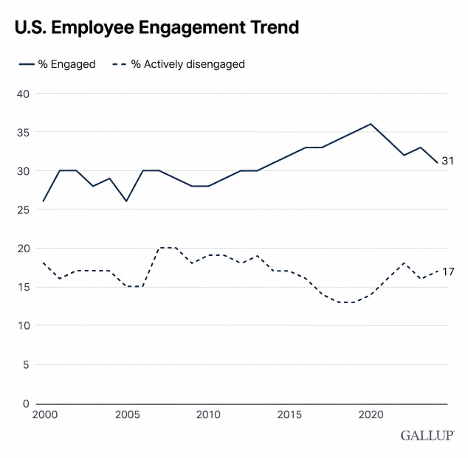
Interestingly, the numbers reported by Don Rheem in 2014 are remarkably similar to Gallup’s most recent findings. Gallup reported that employee engagement in the U.S. fell to a 10-year low in 2024, with only 31% of employees engaged and 17% actively disengaged.⁴
Three Simple Ways to Foster Employee Engagement
For farm owners, leaders, supervisors and managers, the question is not simply how many employees are engaged. If employee engagement has remained relatively unchanged over the past decade, the more important question should be : What can I do differently to help my employees become more engaged?
Too many farm owners or managers simply complain about employees rather than see the problem as something for which they are responsible. Patrick Lencioni offers a practical way to look at this challenge. In his book “The Truth About Employee Engagement”, he identifies three common causes of job dissatisfaction that can contribute to disengagement: anonymity, irrelevance, and immeasurement.⁵
These concepts focus on three basic needs employees have at work: to be known as individuals, to understand why their work matters, and to have a way to track their progress. Addressing these areas can give farm leaders practical ways to strengthen employee engagement.
Start Today: Ask Your Employees and Take Action
Start today by asking your employees how they experience working on your farm. Access the anonymous “Working on This Farm” survey and use it as a reference or template to gather honest, direct feedback from your team.
Listening to employee perspectives is an important first step toward identifying opportunities for improvement and building a stronger, more supportive workplace.
Most importantly, it can help you determine whether your employees would recommend your farm as a great place to work, a meaningful indicator of employee engagement.
Conclusion
Employee engagement does not improve by chance. It requires intentional leadership, consistent communication, and a willingness to listen and act on employee feedback.
Help your employees feel valued as individuals, understand how their work makes a difference, and see the impact of their contributions. By taking these steps today, you can begin building a more engaged team and a stronger more stable workforce for the future.
Published: Oct. 19, 2026
Reviewed by: Robert A. Milligan, Ph. D, Senior Consultant at Dairy Strategies LLC and Professor Emeritus at Cornell University, and Phil Durst, Extension Dairy & Beef Cattle Health and Production Educator at Michigan State University
References
- Gallup. (2017). State of the American Workplace. https://www.gallup.com/workplace/238085/state-american-workplace-report-2017.aspx
- Gallup. (2022). The benefits of employee engagement. https://www.gallup.com/workplace/236927/relationship-engagement-work-organizational-outcomes.aspx
- Rheem, D. (2018). The four levels of employee engagement. Forbes Books. https://books.forbes.com/author-articles/four-levels-employee-engagement/
- Harter, J. (2025, January 13). U.S. employee engagement sinks to 10-year low. Gallup. https://www.gallup.com/workplace/654911/employee-engagement-sinks-year-low.aspx
- Lencioni, P. (2007). The truth about employee engagement: A fable about addressing the three root causes of job misery. Jossey-Bass.