
Common questions about how milk moves from farm to plant, and what it costs.
About 1 Cent
Per CWT per mile to move milk (rule of thumb)
5x Farther
Average haul to a fluid milk plant (101 miles) versus a cheese plant (20 miles)
$0.51 per CWT
Average hauling deduction, Upper Midwest, May 2025
Is there a standard sourcing radius for a dairy plant?
No. There is no industry standard, formal or informal, for how far a plant sources its milk. Hauling distance is an outcome of economics: the cost of moving milk, the density of milk production around the plant, the plant type, competition among handlers, and existing supplier relationships. Some plants fill their needs within an hour of the plant while others buy milk from states away.
How far does milk actually travel?
The most rigorous national estimates come from the U.S. Dairy Sector Simulator (USDSS), a spatial model of milk assembly and product distribution across the 48 contiguous states. Weighted mean distances, October 2021 analysis:
| Product | Assembly: Farm to Plant | Distribution: Plant to Market |
|---|---|---|
| Fluid milk | 101 miles (max 1,883) | 36 miles (max 308) |
| American cheese | 20 miles (max 150) | 568 miles (max 2,555) |
| Other cheese | 24 miles (max 264) | 406 miles (max 2,676) |
Cheese plants locate near the milk and ship the finished product long distances. Fluid plants locate near customers and reach farther for raw milk. Raw milk is bulky and costly to move, so processing that removes water happens close to the farm. Ranges are wide, so these are central tendencies rather than rules. The distances come from a systemwide cost-minimizing model, not from actual hauling records, though industry transportation feedback indicates they mirror real-world patterns.3
What does it cost to move milk? A rule of thumb
About 1 cent per cwt per mile, or roughly $1.00 per cwt per 100 miles. Analysis cited at the Federal Milk Marketing Order hearings put transport costs at $4.60 to $5.00 per loaded mile. A loaded tanker carries about 50,000 pounds, or 500 cwt, and $5.00 per mile divided by 500 cwt equals one penny per cwt per mile. Hauling ran roughly $1.70 to $1.90 per loaded mile in the early 2000s, near 0.35 cents per cwt per mile, so the cost has roughly tripled in 25 years. The cost is not constant with distance: modeled assembly cost runs about 1.3 cents per cwt-mile on a 10-mile haul and roughly half that per mile at 100 miles, so short hauls cost more per mile. Treat the 1-cent figure as a planning approximation, not a quote.3, 5
What do farmers actually pay for hauling milk?
Hauling typically appears on the milk check as a deduction. For May 2025, Federal Order 30 (Upper Midwest) payroll data covering 7,805 farms show a weighted average hauling charge of $0.51 per cwt, or $0.63 excluding farms with zero hauling deductions. Two patterns hold year after year. Charges fall as farm size rises: the smallest farms averaged about $1.14 per cwt and the largest $0.39, largely because many handlers charge flat fees regardless of volume. Geography matters: Wisconsin ($0.47) and Minnesota ($0.46) are lowest because farms sit close to many competing plants, while states with few plants and scattered farms, such as North Dakota, pay the most. Note that the milk check charge is a reported deduction, not a measured cost; milk check analysis by Nicholson finds deductions can interact with premiums and other check terms, so the charge approximates the cost of hauling a given farm’s milk.
Do diesel prices affect milk hauling charges?
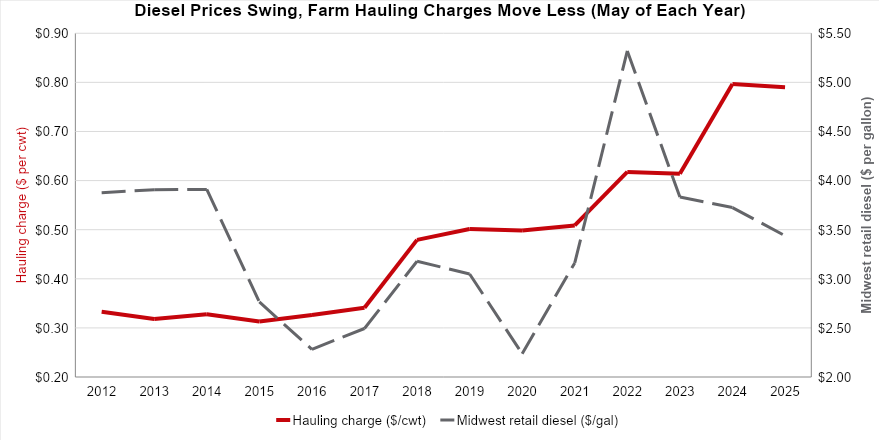
Less than most people expect. In May 2022, Midwest diesel jumped 68 percent from a year earlier while average hauling charges rose 21 percent, and when diesel fell back in 2023 hauling charges barely moved. Federal Order 30 staff conclude that handlers passed on little of the recent changes in fuel costs to farmers. Fuel is only one input in hauling service, alongside capital and labor, which are predominant, so hauling charges would not be expected to track diesel closely.1, 2
Do Federal Milk Marketing Orders (FMMOs) set milk hauling charges?
No. Hauling charges are negotiated among farms, haulers, and handlers, and FMMOs do not regulate them. FMMOs address the cost of space in two other ways. Class I location differentials build location value into regulated minimum prices; these were updated effective June 1, 2025, informed in part by USDSS transportation analysis, raising differentials by a national average of $1.24 per cwt.6 The Appalachian, Florida, and Southeast orders also operate transportation credits and delivery credits that offset the cost of moving supplemental milk into those milk-deficit markets.7
Sources and Attribution
- Federal Order 30 Market Administrator, Milk Hauling Charges in the Upper Midwest Marketing Area: May 2025, Staff Paper 25-03 (A. Kichkha, September 2025) and prior years including Staff Paper 23-01 (C. Freije, April 2023). fmma30.com/Staff_Papers.html.
- U.S. Energy Information Administration, Midwest retail diesel prices, as reported in source 1.
- U.S. Dairy Sector Simulator, October 2021 analysis; distances provided by Dr. Charles Nicholson and Dr. Mark Stephenson, 2026.
- M. Stephenson, Class I testimony, Exhibit MIG-16, National FMMO Pricing Hearing, ams.usda.gov.
- National Milk Producers Federation transportation cost analysis, 2023-24 FMMO hearing record.
- USDA AMS, FMMO final rule, Federal Register, January 17, 2025, effective June 1, 2025.
- USDA AMS, final rule on transportation credit and distributing plant delivery credit provisions in the Appalachian, Florida, and Southeast orders, February 2024.
Find additional resources at go.wisc.edu/dairymarkets. Figures are drawn from the cited sources; model results describe systemwide averages and are not standards, recommendations, or individual plant practices.