

Home » Forward Farm Safety Toolbox » Forward Farm Safety Toolbox – Pesticide Handling & Application
Forward Farm Safety Toolbox – Pesticide Handling & Application


Farm Safety Toolbox
Home » Forward Farm Safety Toolbox » Pesticide Handling & Application
Pesticide Handling and Application Safety Tool
Read in: English | Español (coming soon!)
Pesticides are important for protecting crops, livestock, and farm facilities. However, they can also pose serious health risks if they are mixed, applied, stored, or disposed of improperly. Understanding how to read pesticide labels, wear the right personal protective equipment, and safely handle and store pesticides can help prevent injuries and reduce exposure. Discover ways to safely handle hazardous pesticides on your farm.
Learn
Instructions: Get your team together and share the following information out loud, promoting participation.
Did You Know?
- Pesticides can be dangerous to people, animals, and the environment if not handled and used correctly.
- EPA estimates that doctors diagnose 10,000-20,000 pesticide poisonings each year (NIOSH 2012).
- In one year, research showed that there were 2,606 confirmed cases of pesticide illness across 12 states; agricultural workers were affected at a rate 37 times higher than those not working on farms (Calvert et al. 2016).
- Restricted use pesticides (RUPs) used on farms can cause significant harm to the environment or to people and are more controlled through regulation. In Wisconsin, you must be certified to buy or use RUPs.
- The Worker Protection Standard (WPS) is a rule that can reduce the risk of pesticide poisoning among workers and handlers on farms.
- Personal protective equipment (PPE) helps reduce your body’s exposure. PPE requirements are listed on the pesticide label. Common PPE used to handle or load pesticides can include gloves, eye protection, and respirators.
- In fact, EPA estimates that among the estimated two million agricultural workers in the United States, physicians diagnose 10,000-20,000 pesticide poisonings each year (NIOSH 2012).
- The National Institute for Occupational Safety and Health (NIOSH) identified 2,606 confirmed cases of acute occupational pesticide illness across 12 states; agricultural workers were affected at a rate 37 times higher than nonagricultural workers (Calvert et al. 2016).
What Can Happen to You?
- Start a conversation about the possible impact on individuals, families, the farm, etc. if an incident occurs.
- Ask participants whether they’ve seen or experienced a pesticide exposure.
- Types of pesticide poisoning
- Examples of common exposure scenarios
- Injury or harm to bystanders, animals or the environment
- Death
- Other?
What are the Risk Factors?
- Chemical toxicity levels: Toxicity is a measure of how harmful a chemical can be. A toxicity signal word is on the pesticide label. These can be Caution, Warning, Danger, or Danger-Poison.
- “Caution” is found on labels of the least toxic products
- “Danger-Poison” represents the most toxic products.
- Remember that all pesticides are hazardous to handle and can be harmful regardless of their signal word.
- Routes of exposure: Pesticides can enter the body through your skin, through your lungs as you breathe, your eyes, or by swallowing. We always want to reduce exposure when working.
- Environmental conditions: Wind, heat, and enclosed spaces can increase exposure. Wind causes pesticides to drift or move and can increase exposure to workers. Heat can cause hazardous working conditions for pesticide applicators when they wear heavy PPE. Working in an enclosed space increases your risk of breathing in dangerous chemicals.
- Human factors: Lack of training or experience can lead to harm. Follow the pesticide label and WPS rules to protect yourself and other workers. Make sure you are following all label requirements for application, posting place where pesticides are applied, and notification.
- Job Duties: Mixing and loading pesticides is the most hazardous activity because you handle the highest concentration and quantity of pesticide, leaving you at the greatest risk for high-dose exposure.
- PPE Use: Make sure PPE is properly stored, worn, and maintained. Wear all PPE required by the pesticide label. The required PPE can change depending on the task. Additional PPE may be required when mixing and loading pesticides. Some jobs might require less PPE such as spraying from a closed-cab field sprayer. However, using a backpack sprayer will probably require more PPE.
- Label misunderstanding: Always read the pesticide label to know the required PPE and first aid steps in case you are exposed. If a label is not available in Spanish, use the EPA’s Spanish Translation Guide for Pesticide Labeling to translate the human health and safety sections of the label from English to Spanish.
- Improper storage and mixing areas: Store pesticides in secure facilities to protect people, other organisms that are not pests, and the environment. When mixing and loading pesticides work carefully to avoid splashes and spills.
- What else have you seen or experienced?
Explore
Exploration Activities (pick one or two)
Demonstrate
- Label information: As a group, read a pesticide label. Discuss the identifying, use, safety and environmental information. What PPE is required to use the pesticide or be in an area where the product was used?
- Practice using the EPA’s Spanish Translation Guide for Pesticide Labeling: Do you understand the human health and safety sections of the label? If not, practice finding and translating terms and phrases.
- PPE: Have a volunteer demonstrate where to find PPE and how to correctly wear different pieces, including gloves, chemical resistant aprons, coveralls, respiratory protection, and eye protection. Show the different types of respiratory protection from masks to cartridge respirators. Remind the group that each respirator works differently, and you must use the type specified on the label. Ask observers to comment on what PPE may be missing, running low, or in need of repair.
- Responding to an Exposure: Have a volunteer demonstrate how to respond to a pesticide exposure for each route of exposure: skin contact, breathing, eyes or swallowing. Ask observers to comment on what might be missing or improved. As a group, discuss how coworkers would safely assist the exposed worker.
Walk-Around
- Identify pesticide use areas: Locate areas where pesticides are stored, mixed and loaded, applied, and disposed of on the farm. Discuss how workers may be exposed to pesticides in those different areas.
- Posting and notification: Ask volunteers to point out where key safety signage and information is located on the farm. What do these signs mean? Why are they important? How should they be followed?
- Identify issues: Create staged hazards (unlabeled jug, incorrect PPE, improper storage, etc.) and have participants identify what must be corrected.
Story and Lessons from Participants
- Encourage participants to share stories or examples of situations, close calls, or actual incidents they’ve seen.
- How did it happen? What happened afterward? What were the outcomes (cost, pain, medical, damage, emotional reactions)? What lessons did they learn from this experience?
Case Study
In April 2014, 20 farm workers were tying cherry tree branches to trellises in a Washington state orchard. In a neighboring pear orchard, two applicators were using tractor-pulled airblast sprayers to apply a mixture of insecticides and fungicides. The cherry orchard workers had not been notified about the application. When wind direction shifted during spraying, the pesticide mixture drifted across the property line. Workers were as close as 30 feet from the spray. All 20 workers reported symptoms within minutes. Sixteen sought medical treatment for neurologic, gastrointestinal, eye, and respiratory symptoms. Testing confirmed pesticide residues on surfaces in the cherry orchard and on workers’ clothing (Calvert et al. 2015).
DISCUSS:
- What factors contributed to this incident?
- Environmental factors?
- Human factors?
- Label misunderstanding?
- Lack of notification?
- Surrounding conditions or other factors?
- If you were to go back in time and advise the workers, what is the most important advice you can give?
- How would your advice differ for the cherry orchard and pear orchard workers?
- How does this incident compare to your experience using pesticides or working in or near areas where pesticides are used?
Non-Negotiables
Now that you’ve had a chance to explore a pesticide label and personal protective equipment, let’s review the non-negotiable safety rules. These are not guidelines or preferences; they are mandatory requirements that apply every time, to everyone – regardless of situation, location, or role.
- Read and follow the pesticide label.
- Always wear the required personal protective equipment.
- Never enter a treated site if the restricted entry interval has not expired.
- Store pesticides securely in a locked storage area.
- Know first aid steps and emergency procedures in case of exposure.
- Obtain proper training and required certification before applying pesticides, if needed.
- Ask for help if you do not understand a pesticide label.
- Promote safety culture by encouraging your coworkers to use pesticides safely.
Solve
Instructions: Lead a discussion on how to apply toolbox concepts to your farm.
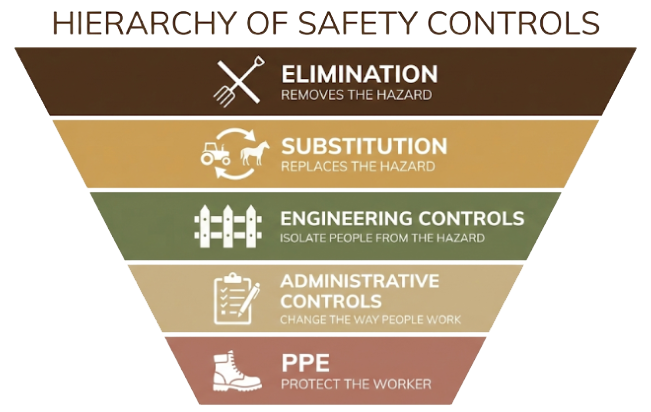
1. Explain the hierarchy of controls at each level
The hierarchy of controls is a standardized, five-level framework used in occupational health and safety to minimize or eliminate employee exposure to hazards.
Examples:
- Elimination: Can we use cultural or mechanical controls (i.e., mowing, cultivation) instead of pesticides?
- Substitution: Can we choose a less toxic pesticide formulation to decrease our risk?
- Engineering controls: Can we use closed transfer systems or improve ventilation to decrease pesticide exposure?
- Administrative controls: All new employees must complete pesticide safety training or become certified before handling any pesticide or working in areas where pesticides are used.
- PPE: Use chemical-resistant gloves, protective eyewear, respirators, etc.
2. What about my farm?
Instructions: Now we will apply what we learned today. Follow the activities.
Form breakout groups
- Ask participants to divide into groups of 3-4 (or discuss with the trainee if there is only one).
- Each group designates one person as the “reporter.”
Discuss
- How does today’s training relate to the things that happen on your farm? (Hazards, risk factors, non-negotiables, stories)
- What other non-negotiables apply to your farm?
- How can we apply the ideas from the hierarchy of controls?
After 5-10 minutes, have groups “Report Out”
- Instructors should write down key ideas, insights, and solutions shared by groups.
- Give positive feedback as participants suggest solutions. This reinforces good safety thinking.
3. Give each person a “pledge form.”
- Participants should write down the top three safety actions they learned today that will improve their ability to safely handle pesticides and reduce pesticide exposure. It is okay to write more than three, but they should clearly identify the highest-priority items.
- Answers should be specific and actionable. For example, instead of “reduce exposure,” write “wear required PPE to reduce exposure.”
- For each action, indicate who will do it and when it will be completed. Focus on concrete, prioritized next steps.
- Decide what you’re going to do with “pledge” information.
Contact:
For questions about pesticide safety education or certification, contact the Pesticide Applicator Training Program at UW-Madison Extension.


References
- Calvert, G. M., Rodriguez, L., & Prado, J. B. (2015). Worker illness related to newly marketed pesticides — Douglas County, Washington, 2014. Morbidity and Mortality Weekly Report, 64(2), 42–44.
- Calvert, G. M., et al. (2016). Acute occupational pesticide-related illness and injury — United States, 2007–2011. MMWR Surveillance Summaries, 63(55), 11–16.
- National Institute for Occupational Safety and Health (2012). A Story of Impact: NIOSH Pesticide Poisoning Monitoring Program Protects Farmworkers.