

Home » Forward Farm Safety Toolbox » Forward Farm Safety Toolbox – Cow Handling
Forward Farm Safety Toolbox – Cow Handling


Farm Safety Toolbox
Home » Forward Farm Safety Toolbox » Cow Handling
Cow Handling Safety Tool
Read in: English | Español
Cattle are a key component of many agricultural operations, but working with them requires awareness and respect. Animal-related injuries are a leading cause of harm in agricultural settings, regardless of how much experience a farm worker may have. Understanding how cattle perceive their surroundings and greater awareness of how to navigate in confined spaces with animals essential. Discover practical strategies to promote safe, low-stress animal handling on your farm.
Learn
Instructions: Get your team together and share the following information out loud, promoting participation.
Did You Know?
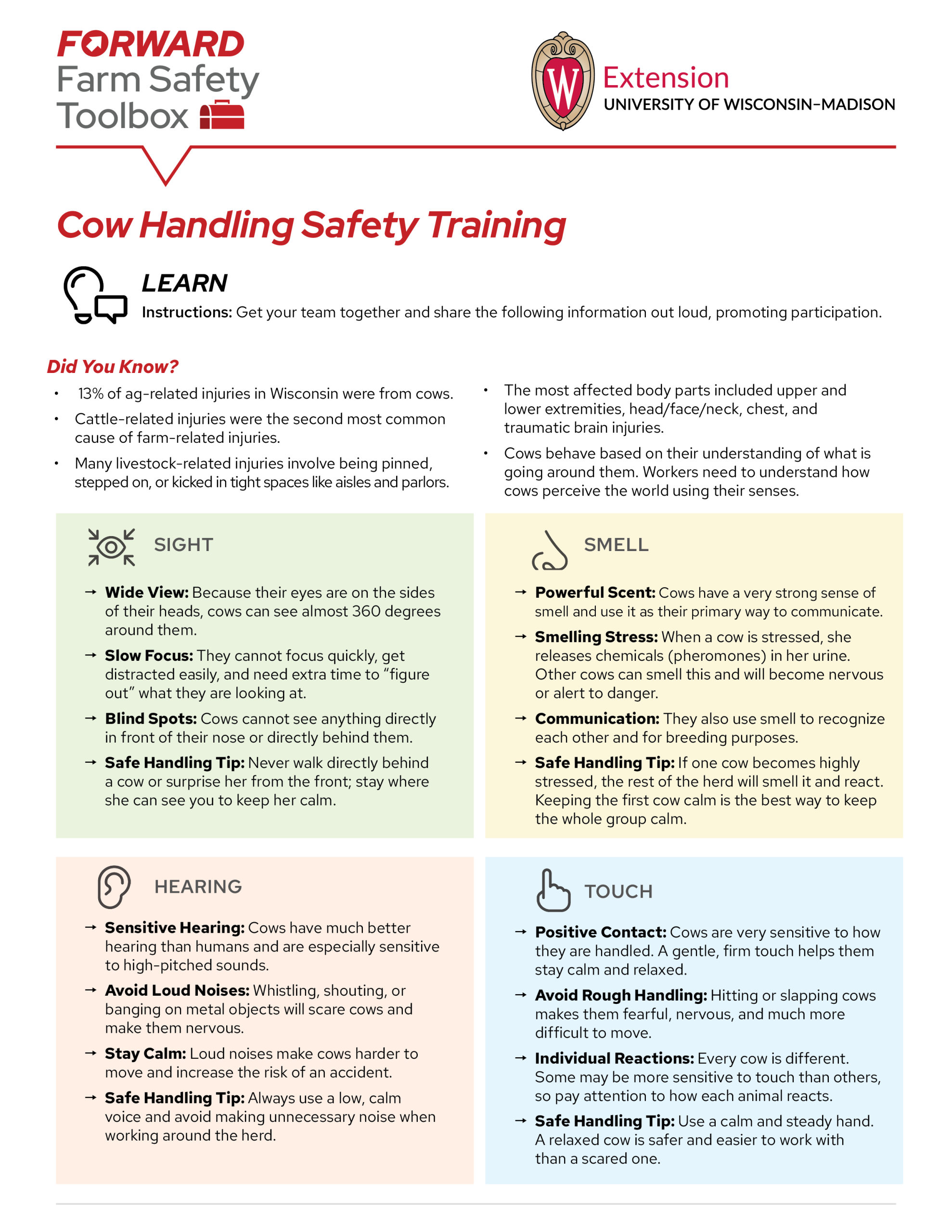
- 13% of agriculture-related injuries in Wisconsin were from cows. (1)
- Cattle-related injuries were the second most common cause of farm-related injuries. (1)
- Many livestock-related injuries involve being pinned, stepped on, or kicked in tight spaces like aisles and parlors.
- The most affected body parts included upper and lower extremities, head/face/neck, chest, and traumatic brain injuries (1)
- Cows behave based on their understanding of what is going around them. Workers need to understand how cows perceive the world using their senses.

Sight
- Wide View: Because their eyes are on the sides of their heads, cows can see almost 360 degrees around them.
- Slow Focus: They cannot focus quickly, get distracted easily, and need extra time to “figure out” what they are looking at.
- Blind Spots: Cows cannot see anything directly in front of their nose or directly behind them.
- Safe Handling Tip: Never walk directly behind a cow or surprise her from the front; stay where she can see you to keep her calm.

Hearing
- Sensitive Hearing: Cows have much better hearing than humans and are especially sensitive to high-pitched sounds.
- Avoid Loud Noises: Whistling, shouting, or banging on metal objects will scare cows and make them nervous.
- Stay Calm: Loud noises make cows harder to move and increase the risk of an accident.
- Safe Handling Tip: Always use a low, calm voice and avoid making unnecessary noise when working around the herd.

Smell
- Powerful Scent: Cows have a very strong sense of smell and use it as their primary way to communicate.
- Smelling Stress: When a cow is stressed, she releases chemicals (pheromones) in her urine. Other cows can smell this and will become nervous or alert to danger.
- Communication: They also use smell to recognize each other and for breeding purposes.
- Safe Handling Tip: If one cow becomes highly stressed, the rest of the herd will smell it and react. Keeping the first cow calm is the best way to keep the whole group calm.
- Positive Contact: Cows are very sensitive to how they are handled. A gentle, firm touch helps them stay calm and relaxed.
- Avoid Rough Handling: Hitting or slapping cows makes them fearful, nervous, and much more difficult to move.
- Individual Reactions: Every cow is different. Some may be more sensitive to touch than others, so pay attention to how each animal reacts.
- Safe Handling Tip: Use a calm and steady hand. A relaxed cow is safer and easier to work with than a scary one.
What Can Happen to You?
- Discuss the potential impact on individuals, families, and the farm in the event of an incident.
- Ask the participants whether they’ve seen or experienced unsafe practices with cows.
- Handlers can be crushed or pinned against fences by heavy animals.
- Kicks or strikes can cause severe fractures and bruises.
- Zoonotic diseases can lead to human illness and economic harm to the farm
- Fatalities occur from trampling or attacks by aggressive animals.
What are the Risk Factors?
- Size and strength: A single cow can outweigh a person 10 times over, so even minor contact can cause injury.
- Noise: Loud noises and yelling increase animal stress and unpredictability.
- Herd instinct: Isolating a single animal often triggers agitation and aggression.
- Maternal Behavior: Mothers protecting their young are extremely defensive and dangerous.
- Light-Shadow Sensitivity: Changes in lighting or shadows cause animals to balk.
- Facilities: Poor facility maintenance creates tripping hazards and escape failures.
- Overcrowded pens: Limited space reduces escape routes and makes it harder for a person to maintain a safe distance from cow’s sudden movements
- Experience Level: Inexperienced handlers may misinterpret early signs of aggression, such as a cow lowering its head and staring directly at someone
- What else have you seen or experienced?
Move cows effectively, learn about the handling zones
Point of Balance: The point of balance is usually located at the cow’s shoulder. Standing behind the point of balance cow moves forward, standing in front of the point of balance cow moves backward or turns away.
Blind Spot: A cow’s blind spot is the area directly behind the animal where it cannot see you at all. Stay away from this zone. Entering a cow’s blind spot can:
- Startle the animal
- Trigger a kick or sudden step backward
- Cause the cow to swing around quickly, which can knock someone down
Tip: Always position yourself at the cow’s side where they can see you clearly.
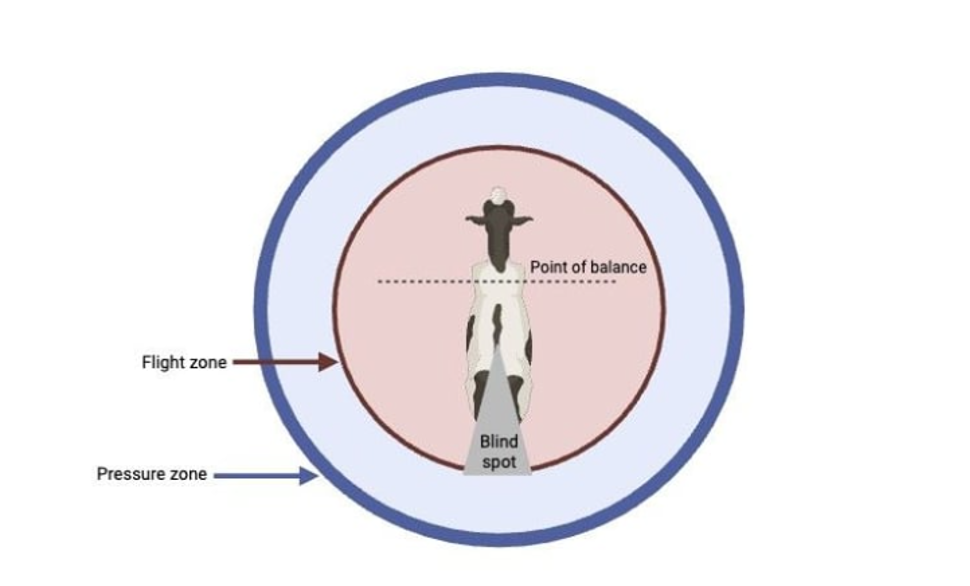
Flight Zone: it is the animal’s personal space, the distance at which it begins to feel uncomfortable and will move away when a person enters that space.
Pressure Zone: This is the area outside the flight zone where the cow can see you but doesn’t feel pressured to react.
Explore
Instructions: Hands on time! Go to the barn and follow the activities below.
Exploration Activities (pick one or two)
Demonstrate
1. The “Flight Zone” Demonstration
Activity: Have a volunteer to approach the flight zone
- Walk slowly toward a calm animal to identify the edge of its flight zone. Observe the cow reaction when the zone is entered
- Discuss: How did the cows react when the handler entered the flight zone
2. The “Point of Balance” Demonstration
Activity: Have a volunteer move the cows forward and backward
- Stand at the animal’s shoulder (point of balance). Step forward to make it move back, and step back to make it move forward.
- Discuss: How did the cows react when the handler crossed the “Point of Balance”? In what situations you will use the cow’s point of balance to move your cows.
3. Facility Assessment
Activity: Inspect the holding pen and return alleys for distractions (like a hanging chain or a coat) that make cows stop moving.
- Discuss: Show how animals balk at the visual distraction compared to a clear path,
- Identify: Locate areas where traction is poor or where gates do not swing smoothly.
- Identifying a route to exit is important to know ahead of time in case a rapid exit is necessary to escape from an aggressive animal or dangerous situation.
Walk-Around
- Inspection: Check all gates and chutes to ensure latches work properly
- Exits: Identify specific escape routes in pens, corrals, and other confined areas
- Lighting: Evaluate lighting in facilities/chutes to ensure it is diffuse and shadow-free
- Behavior check: Walk through pens to identify signs of aggressive behavior in cows.
- Traction: Check for slippery areas to prevent people and cows falls and slips around the farm
Story and Lessons from Participants
- Encourage participants to share stories or examples of situations, close calls, or actual incidents they’ve seen.
- How did it happen? What happened afterward? What were the outcomes (cost, pain, medical, damage, emotional reactions)? What lessons did they learn from this experience?
Case Study
In 2018, a female farm worker in her 60s died when she was struck/pinned by dairy cows and/or a bull while moving them from a freestall area (where the cows eat and stay when not being milked). The freestall area had a roof and walls open to the outdoors. One side of the freestall had a curtain/canvas that had not yet been rolled up and was in the down position. On the curtain side were stalls, separated by stanchions in which the cows could lay down. The farm owner was working outside of the freestall area, on the opposite side of the curtain, approximately 25-30 feet away. The victim was moving the animals so she could scrape manure from the pen floor. The owner heard the animals rushing/moving forcefully and went to the pen to determine what was causing the commotion. The owner found the decedent lying face down in one of the stalls located near the pen opening. The sequence of events was unknown; it was thought she was struck/pinned by a cow or the bull.
DISCUSS:
- What factors contributed to this incident?
- Worker factors?
- Animal behavioral factors?
- Surrounding conditions or other factors?
- If you were to go back in time and advise the farm worker, what is the most important advice you can give?
- How does this incident compare to your experience working around cows?
Non-Negotiables
Now that you’ve had a chance to learn and explore cows’ characteristics and behavior, let’s review the non-negotiable safety rules. These are not guidelines or preferences; they are mandatory requirements that apply every time, to everyone regardless of situation, location, or role.
- Always plan a clear escape route before entering an enclosure.
- Never approach cows from their blind spot behind the rear.
- Remain calm and quiet; never yell or make sudden movements.
- Wear steel-toed boots and appropriate personal protective equipment at all times.
- Respect the flight zone and never crowd animals unnecessarily.
- Stay visible to the cow, and maintain extra space in maternity pens.
- Eliminate distractions like flapping chains or shadows in alleyways.
- Do not work alone with aggressive or unpredictable animals.
- Never try to overpower a cow, respect their strength.
- Avoid entering areas where cows are tightly crowded, such as the parlor holding pen.
What other non-negotiables are important for your farming operation?
Solve
Instructions: Lead a discussion on how to apply toolbox concepts to your farm.
1. Explain the hierarchy of controls at each level
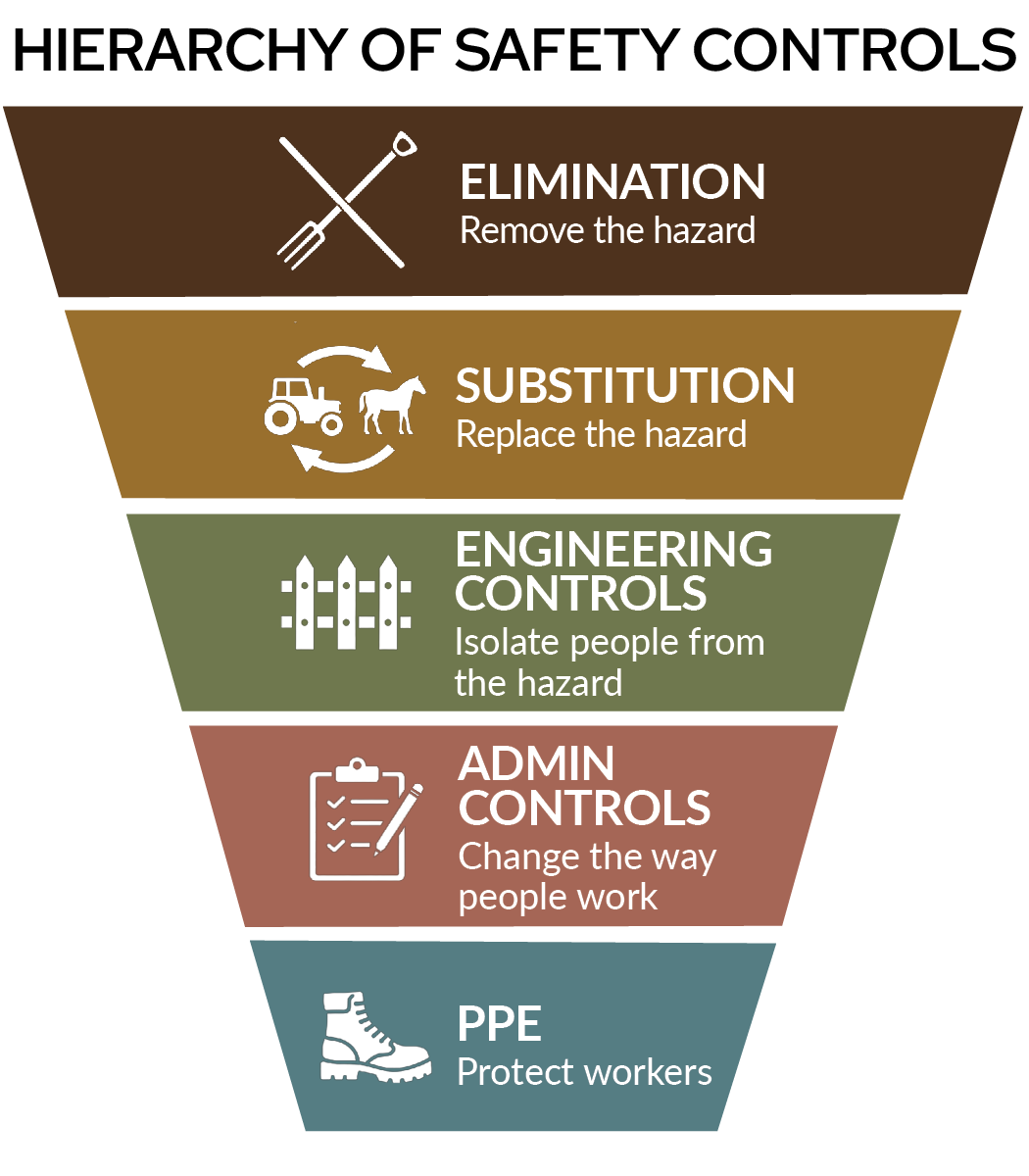
The hierarchy of controls is a standardized, five-level framework used in occupational health and safety to minimize or eliminate employee exposure to hazards.
Examples:
- Elimination: Remove aggressive animals from the herd to prevent future injuries to handlers or other cattle.
- Substitution: Swap slippery flooring in pens or alleys with textured, non-slip surfaces to reduce slips for cows and handlers.
- Engineering controls: Use headlocks, squeeze chutes, and gates that restrain animals safely and reduce the need for close human contact.
- Administrative controls: Limit the number of people in pens to reduce confusion and stress for the animals.
- PPE: Use steel-toe boots to protect yourself from being stepped on by cows and wear safety glasses to keep manure out of your eyes if cows get startled and run.
2. What about my farm?
Instructions: Now we will apply what we learned today. Follow the activities.
Form breakout groups
- Ask participants to divide into groups of 3-4 (or discuss with the trainee if there is only one).
- Each group designates one person as the “reporter.”
Discuss
- How does today’s training relate to the things that happen on your farm? (Cow behavior, risk factors, non-negotiables, stories)
- What other non-negotiables apply to your farm?
- How can we apply the ideas from the hierachy of controls?
After 5-10 minutes, have groups “Report Out”
- Instructors should write down key ideas, insights, and solutions shared by groups.
- Give positive feedback as participants suggest solutions. This reinforces good safety thinking.
3. Give each person a “pledge form.”
- Participants should write down the top three safety actions they learned today that will improve their ability to safely work around cows. It is okay to write more than three, but they should clearly identify the highest-priority items.
- Answers should be specific and actionable. For example, instead of “handling cows properly,” write “ Approach cows calmly and from the side where they can see me.”
- For each action, indicate who will do it and when it will be completed. Focus on concrete, prioritized next steps
- Decide what you’re going to do with “pledge” information.
Supplemental Learning

Dairy Stockmanship – Upper Midwest Agricultural Safety and Health Center (UMASH)
En Español – Dairy Stockmanship – UMASH
References
- Modji, Komi K. S., et al. 2025. “Cow-Related Injuries in Wisconsin During 2017–2023.