
Read in: English | Español
ARTICLE Contents
What is a Total Compensation Statement?
Components of Total Compensation
How Employees Benefit from Total Compensation
How Employers Benefit from Total Compensation
For Download: Total Compensation Statement
- Example Statement (PDF)
- Fillable Template (.xlsx)
Introduction to Total Compensation Statements
Understanding the total value of annual compensation statements is important for both employers and employees.
For employers, providing a Total Compensation Statement demonstrates the value of employees’ contributions and reinforces commitment to their well-being. It supports a positive workplace culture and highlights the organization’s investment in long-term success.
For employees, reviewing the Total Compensation Statement provides a complete understanding of the total value of their employment. This awareness promotes informed decision-making, enhances appreciation for the organization’s investment, fosters transparency, and supports more effective financial planning. Paychecks reflect only part of the compensation; the statement shows the full range of benefits and rewards provided by the employer.
What Is a Total Compensation Statement?
A Total Compensation Statement is a document outlining an employee’s complete compensation which summarizes the complete rewards package beyond base pay. This package or total Rewards System (Güngör, 2011) 1 is a mixture of monetary and nonmonetary awards used to recruit, retain, motivate, and satisfy employees to improve efficiency and effectiveness and promote desirable attitudes in the workplace. The total rewards system encompasses traditional quantifiable elements like fixed pay, variable pay, and benefits.
Components of Total Compensation
The benefits and compensation offered to employees vary depending on the financial capacity and priorities of each farm or organization.
Note: Not all employers provide every indirect benefit listed below; offerings depend on the organization’s resources and priorities.
Direct Compensation
- Base Salary or Hourly Wages: The fixed amount paid to an employee for work performed.
- Bonuses and Incentives: Additional pay based on performance or other achievement-related factors.
Indirect Compensation and Benefits (if applicable)
- Employer contributions to Social Security and Medicare taxes
- Employer contributions to retirement accounts
- Paid time off, such as sick leave, vacations, and holidays
- Maternity and family leave
- Workers’ compensation coverage
- Life and disability insurance
- Paid professional development, such as seminars and training
- Cell phones or communication allowances
- Transportation assistance
- Housing Stipend
- Uniforms
- Health and dental insurance
Total Compensation Chart
According to Bureau of Labor Statistics 2 total employer compensation costs for the private industry in June of 2025, wages and salaries accounted for 70.2 percent of the employer cost, while benefits accounted for the remaining 29.8 percent.
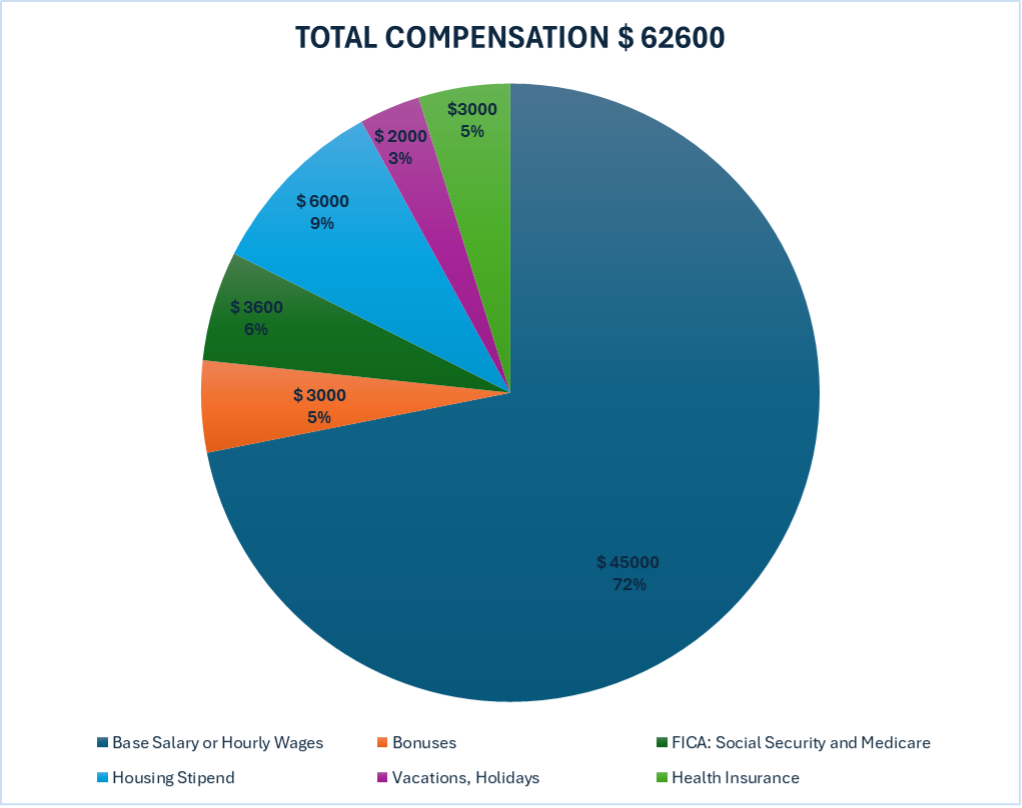
Figure 1 illustrates an example of a total compensation breakdown based on a base salary of $45,000, including additional benefits such as housing stipends and performance bonuses, components commonly found in agricultural operations.
How Employees Benefit from Total Compensation
Reviewing a Total Compensation Statement helps employees recognize the full value of their employment, including the additional benefits provided.
- Informed Decision-Making: Understanding available benefits supports better choices when evaluating job satisfaction or considering other employment opportunities.
- Emotional Well-Being: Recognizing the full scope of compensation can increase appreciation for the organization’s investment in its employees.
- Clarity and Transparency: Total Compensation Statements provide a clear picture of the complete value of an employee’s compensation.
- Financial Planning: Awareness of employer-provided benefits helps employees and employers identify areas where additional personal coverage or savings may be needed.
How Employers Benefit from Total Compensation
Investing time, money, and effort to recruit and retain talented employees is critical for farm businesses. An effective Total Rewards system is a vital human resources management strategy for attracting, retaining and motivating employees to enhance organizational performance 3. Communicating a total compensation statement offers several advantages for the organization:
- Motivation and Engagement: Sharing total compensation with employees help them feel valued by their employer, which can increase employee motivation and engagement
- Employee Retention: When employees see the full value of their compensation package, satisfaction increases, reducing turnover.
- Improved Recruitment: Employees who feel valued and appreciate their benefits are more likely to recommend the organization to others, supporting recruitment efforts.
- Increased Productivity: Employees who understand and use benefits such as wellness programs and vacation time tend to be healthier, well-rested, and more focused on their work.
- Building Trust: Providing a Total Compensation Statement demonstrates a commitment to employees’ growth and well-being, reinforcing that the organization offers a career, not just a paycheck. The professionalism and organization demonstrated in the delivery of the total compensation statement can strengthen employees’ trust in the company.
Final Message: Timing and Communication Matters
As an employer, make it a practice to share total compensation reports with your team each year, ideally at the end of the year or at the start of the new year clearly showing the total compensation earned during the previous year.
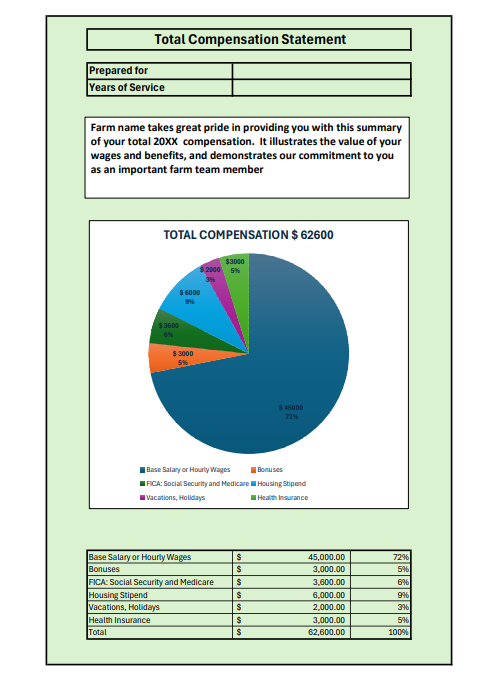
Present these reports in a personalized and transparent manner to help employees see the full value of their contributions. Your efforts to personalize the document can make employees feel special. Printing statements with the team members’ name and years of service can show them that you took the time to organize a compensation statement that is particular to them. Make the statement visually appealing, use charts and graphs, and take the time to explain what each component means. For reference check this excel and pdf template of a Total Compensation Statement.
As an employee, take the time to carefully review and understand your total compensation report. Doing so helps you appreciate the full scope of your benefits, recognize your achievements, and make informed decisions about your career and financial planning.
If you are an employer and have not shared the total statement with your team, please check this excel and pdf template of a Total Compensation Statement to start building yours.
Total Compensation Statement
For Download:
Example Statement (PDF) | Fillable Template (.xlsx)
Published: Nov. 26, 2025
Reviewed by: Robert A. Milligan, Ph. D, Senior Consultant, Dairy Strategies, LLC, Professor Emeritus, Cornell University, and Sarah Janes Ugoretz, PhD (she/her), Farm Labor Extension Educator, UW Madison, Division of Extension
References
- Güngör, P. (2011). The relationship between reward management system and employee performance with the mediating effect of motivation: A quantitative study on global banks. Procedia Social and Behavioral Sciences, 24, 1510–1520. https://doi.org/10.1016/j.sbspro.2011.09.028
- U.S Department of labor– Employer cost for employee compensation-June 2025
- Reza, M. M. H., & Neogy, T. K. (2024). Total rewards as a driver of employee performance: An HRM‑based analytical literature review. Journal of Fareast International University, 7(1), 27–36. https://www.researchgate.net/publication/389114911_Total_Rewards_as_a_Driver_of_Employee_Performance_An_HRM-Based_Analytical_Literature_Review