

This article first appeared on AgProud.com
Introduction
Financial recordkeeping and management are often major stressors for farm owners and managers. Wrestling data and numbers into usable information can feel daunting, but it doesn’t have to. Starting small and following a roadmap from basic recordkeeping to advanced financial analysis can power profitability, planning and peace of mind.
Recordkeeping is the foundation of good financial management. You can think of it like the soil in your fields. If the soil is weak, rocky, or poorly managed, you can’t produce a strong crop no matter how good the inputs or equipment. Accurate records form healthy “financial” soils allowing deep roots for strong analysis, decision-making, and profits to weather any storm our farms might experience. The farm financial management model helps visualize this process (Image 1).
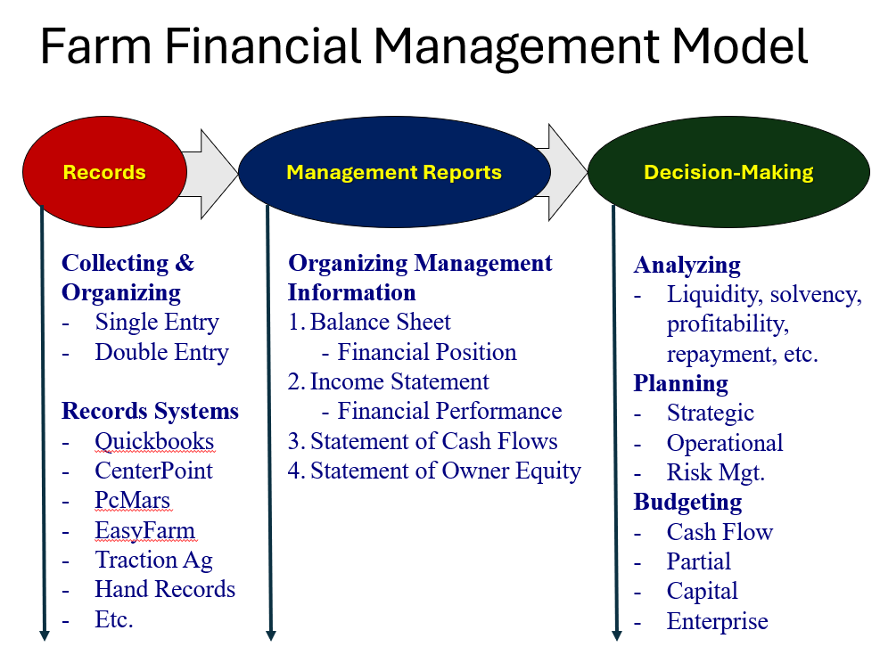
Step 1: Goals
The financial management roadmap helps farmers move from gathering basic records to building reports that can lead to running financial analysis. This provides a solid, well-informed base for decision-making.
However, farmers need to know the “destination” for this roadmap. This is why clearly stated and written farm business goals are the first step in this process. Connecting goals like expansion, succession, profitability, and risk management with the right financial tools to improve your chances of success. It helps you figure out how you can plan for a major change, apply for a loan or grant, add technology or equipment to the business, identify areas for improvement, and determine long-term viability and strategic direction.
Step 2: Recordkeeping
With your goal in mind, start with mastering the foundation of recordkeeping. Accurate records are essential for financial clarity and will support accounting and profitability analysis. Required components of recordkeeping include:
- Keeping your records up to date
- Understanding how you make and spend money for the business and the household
- A complete inventory list
- Collecting and organizing your records
- Selecting a recordkeeping system
Step 3: Reports
After establishing a system that collects and organizes the financial information needed, the next step is creating reports to make better decisions. In this step you want to know how cash flows in and out of your business over the last year and over the next year. You also want to create or collect 3-5 years of balance sheet statements, tax returns, and accrual income statements. If your business is less than 3 years old and you don’t have these, you should consider developing estimates for the next 3 years of your business through a tool like a pro forma analysis.
Having 3-5 years of data helps you understand and examine trends and reduces the impact of just looking at one year which may be unusually good or poor. With management reports in hand, the next steps are analysis and decision making.
Step 4: Decision Making
Reports are not the finish line. They show you what has happened but not what to do next. Analysis turns the data and numbers into insights and choices for the future. In this step, you identify historical trends, compare benchmarks, plan for upgrading and maintaining land, buildings, and equipment, run what-if scenarios, and create projections for the coming years.
You want to understand what is driving profit by using enterprise analysis to see which parts of the business make or lose money. Part of this is identifying high-performing or underperforming components like markets, products, or entire enterprises. It also helps farmers evaluate efficiencies like asset turnover, expense ratios, and costs of production to see if resources are being used wisely.
Run “what-if” tests, also known as sensitivity analyses, to test what would happen if prices, costs, interest rates, etc. drop or rise. Testing different scenarios prepares the business for volatility caused by issues such as market fluctuations, extreme weather, government policies, and changes in consumer sentiment.
Review risk exposure and check resiliency in key areas such as production, finance, marketing, legal, human, and technology. Pull all the insights gained from this analysis together to make decisions that align with your goals.
This is the stage where you are setting your future. You want to pull all your financial data together to build a forward-looking financial plan. Trend analysis, projections, and sensitivity analysis test future decisions and help you decide whether to move forward by identifying your exposure to risk. This allows you to move from reactionary management to proactive preparedness. Building your ability to create advanced financial analyses increases confidence in decision making, helps reduce stress, and strengthens support from family and business partners.
Step 5: Pull it all together
If you walked through the whole roadmap and realized that you have not even completed all the components of recordkeeping, that’s okay. That’s a great place to start. Prioritize your next steps by choosing just 1-2 pieces from that step to work on at a time before moving to the next.
Remember, accurate records are the building blocks for creating reports which allow you to complete financial analyses which, in turn, help you make confident decisions for the future of your farm. Strong foundations create strong decisions that support growth and adaptability.
Using this financial roadmap walks you through the steps of where you are now, where you are going, and how to get there in this 5-step process.
- Step 1: Identify goals
- Step 2: Create accurate records
- Step 3: Build reports
- Step 4: Use analysis tools
- Step 5: Prioritize next steps
You can tackle this one step at a time by starting small and building the habit. Once you build strong habits and financials, make sure to update, monitor, and adjust regularly.
We’ve created a roadmap worksheet to walk you through all five steps and link you with resources to help you complete each step. Download the roadmap and take steps towards gaining control of your finances.
Financial Roadmap Worksheet
Published: July 22, 2026
Reviewed by: Joy Kirkpatrick, Farm Succession Outreach Specialist, UW-Madison Division of Extension, and Kevin Bernhardt, Extension Farm Management Specialist, UW-Platteville