Introduction
This article comes with prerequisite homework. If you haven’t listened to the song “S Lazy H” by Corb Lund, stop reading and go do it, right now.[1] Listen closely to the lyrics.[2] Lund stated in an interview that the song wasn’t one true story, but that it is “an amalgam of stories from people—it’s essentially a true story because it happens a lot.”[3] Truer words have never been said. The “S Lazy H” sings a ballad of the challenges of trying to split up a working ranch between a child who wants to continue the operation, and an off-farm child who wants to realize the value of their inheritance—an undivided half share with their ranch sibling. Listening to the song can be an emotional experience for a farmer or rancher going through the transition process because the song is simply heartbreaking in its accuracy.
Can an equal division of farm assets ever work?
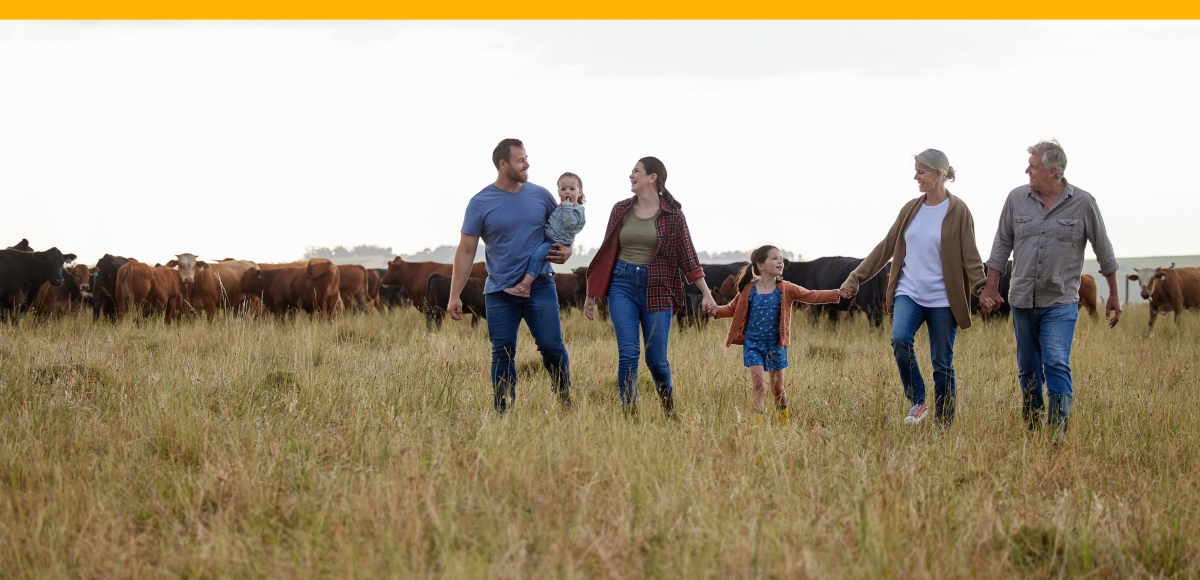
In “S Lazy H,” an on-farm ranching child (let’s call him “Farm Kid”) receives an undivided one-half interest in the ranch after their father’s (“Pa”) death and their mother’s (“Ma”) disability, with the other one-half interest going to their off-farm sibling (“City Kid”). City Kid wants to realize the value of the inheritance and wants to sell the ranch. Wanting to keep the ranch intact, Farm Kid tries to purchase the interest but “no cow-calf operation carries that kind of cash…I’m afraid I had to sell 20 sections of the S Lazy H.” Needless to say, the ranch doesn’t make it.
But is the dissolution of a farm or ranch the inevitable result of splitting the operation into undivided interests? We sought to find out. Since finding real farms and ranches and tracking them through a generational transition poses a generational task itself, we tried the next best thing and simulated an operation with the best fidelity we could.[4]
Using Kansas Farm Management Association (KFMA) data from real farms to develop a “prototypical” winter-wheat/cow-calf operation, we defined an asset base of land, equipment, and livestock along with a balance sheet, income statement, and cash flows. Initially focusing on the southern Great Plains, a winter-wheat and cow-calf operation served as our representative farm. We then vetted our operation with several commercial agricultural lenders who confirmed that the operation represented a farm typical of a full-time commercial rancher. Then, using KFMA net farm income data spanning 20 years, we built a computer simulation that ran the farm through a 20-year period of the ups and downs in farm income.
All of that laid the foundation for the centerpiece of the work: Could such an operation generate enough income to allow one Farm Kid who inherited a one-half undivided interest in the operation to buy out one City Kid’s undivided one-half interest? We played out two variations on this theme—one in which the on-farm heir used commercial loans to make the purchase, and one in a “family friendly” deal with an installment sale over 20 years and the lowest interest rate allowed by the IRS. In other words, could the farm survive this approach, or was it doomed to the fate of the S Lazy H?
Over the course of literally thousands of simulations, the farm survived precisely zero times. Never. Sure, there were years here and there where the farm generated enough income to service the considerable debt demanded by this strategy, but inevitably the variability in farm income would yield enough bad that there was simply no way to make it work. The farm, and Farm Kid, would always be required to exhaust all of the farm’s net income and incur additional debt or nonfarm sources of income to sustain the payments.
Now, before you think to yourself, “Yeah, but that was a cow-calf and wheat operation in the southern Great Plains… I’m a (take your pick: corn, soybean, swine, dairy, vegetable) operation and we cash-flow WAY better than one of THOSE operations,” you should know that since the initial research we have run the model with everything from Iowa corn operations to Utah dairies, and the results of this strategy are almost always identical: The farm simply does not generate enough net farm income to allow for the purchase of half of its equity back from City Kid without a significant contribution of nonfarm income either from off-farm employment of Farm Kid or their spouse, a generous life insurance policy on the life (or lives) of the parents, or substantial off-farm investments that can be liquidated to make the purchase.
Despite all this, over 64 percent of farmers and ranchers choose this strategy that seems doomed to failure, at least if “failure” means the dissolution of the farm asset base. How do we know at least 64 percent of farm operators choose this approach? Because 64 percent of farmers and ranchers don’t have any form of estate plan in place,[5] and this is also the exact scenario that would come about through the intestate succession laws that govern estates if the person who died had no will, trust, or other estate tools.[6] Further, we know this to be the approach of over 64 percent of farmers and ranchers because many of them affirmatively choose this strategy and implement it in their estate tools.
The Conflicting Economic Interests of Farm Kid and City Kid
To this point, the discussion of giving a farm to Farm Kid and City Kid in undivided interests has carried an implied assumption: Farm Kid inevitably will be forced to buy out City Kid. Why do we make that assumption?
Let’s look at our situation from a different perspective. When Ma and Pa give the farm in undivided interests to Farm Kid and City Kid, they have essentially given each of them a share of stock in a business.[7] Assume Farm Kid functions as the CEO of the farm business and makes both the day-to-day and strategic decisions for the business. Let us also consider there are precisely two ways to make money from a stock:
- Receive dividends that are distributed to the shareholders, or
- Sell the stock to realize the value of the stock’s equity value.
Further, assume that (gasp!) Farm Kid and City Kid loved Ma and Pa, they love each other, and they want to see the farm continue operating intact. Recognizing this latter fact, City Kid would be content with receiving a dividend representing a reasonable return on their equity given the level of risk involved as they consider the “opportunity cost” of leaving their investment in the farm.[8] City Kid really doesn’t want to sell their interest and wants to see the success of the farm and Farm Kid, so City Kid views selling their interest in the farm as a last resort. One way or another, City Kid has placed their economic fate in the hands of Farm Kid and Farm Kid’s decision on declaring a dividend for the farm.
Thus, let us turn to Farm Kid. Farm Kid also has no desire to sell their interest, thus to an extent Farm Kid is dependent on dividends as well for their economic return from the farm. However, Farm Kid is also an employee of the farm and its manager, and thus likely receives compensation for those roles out of farm revenue in the form of a family living expense draw. In lean years Farm Kid may reduce that draw, hoping to make up for it in better years. Thus, Farm Kid’s economic incentives are to manage risk and increase profitability (and note to this point those incentives align with City Kid’s as well).[9]
Now, let us assume the farm has a good year. Production is abundant, commodity prices are good, expenses are manageable, and a profit is made. Yes, a dividend could be declared, but gosh, wouldn’t it be good to replace aging equipment, purchase a piece of land that would benefit the operation, or pay off debt? Any one of those things should increase the farm’s long-term profitability or at the very least reduce its risk, but paying a dividend just takes cash out of the operation. Further, note that Farm Kid will likely take a family living draw thus providing them at least some form of economic return from the farm, while City Kid has none. Thus, in a good year, no dividend is declared, and this is not out of malice; it is simply Farm Kid behaving as a rational economic actor.
Conversely, consider a bad year. Crops fail, commodity prices are bad yet input prices are still on the rise, and the farm is trying to manage its losses. Farm Kid tries to reduce cash outlays anywhere possible, likely making minimum debt payments (and perhaps digging deeper into the operating line of credit), trying to defer equipment replacements, and perhaps reducing their family living draw. There is absolutely no incentive for Farm Kid to declare a dividend under such circumstances.
So, to recap:
In a good year for the farm, City Kid will not receive a dividend.
In a bad year for the farm, City Kid will not receive a dividend.
This brings us back to the fact that there are two ways to make money from a stock… and we have now shown City Kid is actually down to just one: sell the stock or simply face the fact their farm interest is a stranded asset. They have no desire to sell it to an outside party (and what outside party in their right mind would buy into a potential family feud) so they sell to Farm Kid, setting up exactly the scenario with zero chance of success. All of this came about without any ill will among the parties; everyone involved simply followed their economic incentives. Further, it was Ma and Pa who put them in this situation. Instead of confronting the dilemma of crafting an equitable division of assets, they instead foisted the issue onto their children.
Why do people frequently pick a strategy with no chance of success?
So why would approximately two-thirds of farmers and ranchers choose this “split it down the middle” strategy? You have probably already heard the explanations. “Oh, but I love my kids equally, so I have to give them exactly the same thing!” “Treating everyone the same is the only fair way to do it!” “Doing it this way is the only way to avoid a fight!”
In all fairness to Ma and Pa in these situations—whomever they may be—their hearts may well be in the right place. From their perspective, they are trying to avoid favoritism toward one child and to demonstrate their equal love toward their children. In their mind an equal division of assets accomplishes this, hence “I love my kids equally, so I have to give them exactly the same thing!” and “Treating everyone the same is the only fair way to do it!” Both of these sentiments come from a good place, but they miss the mark. As for avoiding a fight, an equal division of assets represents a strategy that is virtually guaranteed to have the opposite effect and to drive a wedge in the family. That is because it is a strategy based on a fundamentally flawed assumption: that equal treatment of the parties is also equitable treatment.
The Confusion of “Equal” and “Equitable”
Consider the definitions of these two words:[10]
Equal: of the same measure, quantity, amount, or number as another; like in quality, nature, or status; like for each member of a group, class, or society; regarding or affecting all objects in the same way; impartial
Equitable: dealing fairly and equally with all concerned
To put it as simply as possible, equal is “identical,” equitable is “fair.” And to bring us back to the title of this chapter as Corb Lund stated it, “sometimes right isn’t equal, sometimes equal’s not fair.”
Let’s consider Lund’s song again. As you listen to it, you see that Farm Kid had spent their entire life on the ranch, working alongside Ma and Pa, while City Kid had pursued a profession somewhere else and had little to do with the day-to-day ranch operations. But let’s put some numbers to it: let’s say over the course of 20 years of operating alongside Ma and Pa, Farm Kid had helped double the net worth of the farm. To be sure, some of this growth is attributable to Ma and Pa’s efforts, but by the same token some of it is also attributable to Farm Kid. None of that growth is attributable to City Kid since they have made no contributions of labor, management, or invested at-risk capital. Knowing this, ask yourself: is it fair that Farm Kid and City Kid receive equal, identical, undivided interests in the farm? Your gut probably immediately answers “no.”[11]
The Challenges of Equitable Transitions in Agriculture
“Ok, I’ll grant that,” you’re thinking, “but does that just mean City Kid gets disinherited? That doesn’t seem equitable either!” Your gut is right here, too.
To illustrate why an equitable transition in agriculture pose so many challenges, consider a completely different example. Take the farm completely out of the equation: Pa works for an accounting firm and Ma is a doctor working for a local hospital. They have investment accounts through their respective employers along with some life insurance. Their estate plans call for their two children to receive equal amounts of these investments. What does your gut tell you about this arrangement? Our guess is it probably feels just fine.
Further, we guess two main factors contribute to this. First, this scenario just divides fairly liquid financial assets, not an ongoing business upon which at least some of the family depends for their economic wellbeing. Second, you probably recognize an implicit principle: what is earned is earned, and what is a gift is a gift. Here, there’s no suggestion that either child “earned” anything—everything given to them by Ma and Pa is a gift in every sense of the word, and it makes sense to make equal gifts.
Intuitively, by examining these two scenarios, you have deduced the two core challenges surrounding the “equal versus equitable” problem in a farm transition. If Ma and Pa had significant nonfarm wealth (that is, wealth held in assets that were not actively used by the farm in its operations)— perhaps even equal in value to the farm assets, they might simply give the farm assets to Farm Kid and the nonfarm assets to City Kid. However, farmers often reinvest what distributions they take from their operations in the farm,[12] limiting the amount of nonfarm financial assets available to try to “balance” estate distributions to Farm Kids and City Kids.[13]
The first core challenge is this:
In many cases, the overwhelming majority of assets held by Ma and Pa are business assets vital to the continued operation of the farm. If we give Farm Kid and City Kid equal and undivided interests in these assets and effectively force Farm Kid to buy out City Kid in order to keep the assets together, we place Farm Kid in the economically untenable position discussed above. On the other hand, if the parties decide to sell some of the assets to an outside party to realize their cash value, the farm has lost potentially vital production assets.
In an ideal world, Ma and Pa would have enough nonfarm assets that they could make what they felt was a good estate gift to City Kid, and enough farm assets that they could gift to Farm Kid to maintain a viable farm operation, and everyone would feel content with those gifts. But we don’t live in an ideal world. Land represents just one critical challenge in the calculus of this problem: it is illiquid, it’s not readily divisible, it’s vital to the operation, and it represents over 82 percent of the US farm and ranch balance sheet’s asset value.[14] We’ll discuss how to address this without disinheriting City Kid below.
The second core challenge is this:
What is earned is earned, what is a gift is a gift, but a lack of transparency can blur the line between the two. If you tell your child “Mow the lawn and I’ll give you 10 dollars,” and your child then mows the lawn, they have earned that 10 dollars; it’s not a gift. Conversely, if you give your child 10 dollars in their birthday card just because you love them, that is a gift. These may seem like elementary examples, but they help us frame the issue in the context of a farm transition.
If Farm Kid works on the farm, how are they compensated for their work? In other words, what have they earned? Were they compensated at the full fair market value for their labor, management, and contributions of equipment or other assets? If they were, then one could argue Farm Kid has already received what they earned, and whatever they receive from Ma and Pa in their estates is truly a gift, just the same as anything that is given to City Kid. On the other hand, if Farm Kid has been paid less than the full fair market value for their labor, management, and asset contributions—almost always under a “someday kid this will all be yours” or “sweat equity” arrangement (which is never, ever memorialized in writing), they may well have an expectation that they get something “extra” in Ma and Pa’s estates because they earned it. And if Ma and Pa agree, they give Farm Kid more than City Kid (and again, almost always without explaining why to City Kid) leaving City Kid at best uninformed about the reason for the unequal (but perhaps equitable) treatment, or at worst resentful at their treatment.
This underscores the importance of transparency in the transition planning process. Sweat equity arrangements invite disaster because none of the parties have a clear understanding of what is earned and what is a gift and are thus confused (or resentful, or both) by what they receive especially in comparison with the other parties. On the other hand, if Ma and Pa explicitly establish a value for Farm Kid’s contributions and either pay that value or recognize it by transferring ownership (perhaps in the form of stock or ownership of specific assets), those items are clearly established as earned.
So what can be done?
So far this article has laid out numerous challenges and obstacles, but what about solutions? The good news is there are absolutely tools and strategies Ma and Pa can use to bring about an equitable transition of the farm, leave impactful financial legacies to all their children, and even strengthen family bonds rather than strain them. Cultivating Continuity: Expert Insights for Farm Succession contains numerous resources that can help, but in very brief summary we want to emphasize six important strategies for dealing with the “equal versus equitable” issue.
- Have the talk: Don’t let Farm Kid and City Kid wonder about what is earned, what is a gift, what you value, or how you feel. Communicate, communicate, communicate! We recognize this may be hard since farm families may sometimes be inexperienced in telling those around them how they feel (unless you include yelling over the radio at the family member driving the grain cart as “telling them how you feel”).
Start by just telling them that you love them! Then tell them that you are working to develop a plan to make sure the farm can successfully transition to the next generation. Ask them what their vision for the future of the farm is, and what role they see themselves in as part of that future. If they are not actively involved now, do they think they would want to become involved? How do they think contributions to the farm should be valued, and what kind of contributions are they willing to make? Asking these and other questions gives all the stakeholders involved a chance to start thinking about the issues involved in a transition and invites them to formulate solutions as opposed to simply being upset if a solution is forced upon them. - Explicitly and transparently recognize the market value of Farm Kid contributions: As mentioned above, establishing an explicit value for Farm Kid contributions of labor, management, capital, and/or assets is critical for transparency to everyone involved. If those contributions are being compensated at a value below fair market value, it may be time to increase compensation or to make equity transfers as added compensation (and creating an operating entity such as a corporation or LLC might facilitate this). On the other hand, if it is simply not possible to compensate those contributions at their fair market value, it is time to consider the financial performance of your operation. Is it underperforming for some reason? Are their efficiencies it could gain or unnecessary expenses that could be eliminated? Or is it simply not financially viable standing on its own without support from nonfarm income? This may be a difficult self-examination for a farm to undertake, but it is also a vital one.
- If the value of land is an obstacle to an equitable transition, take it out of the equation: As mentioned above, farm families may not have an abundance of nonfarm assets to transfer to City Kid, land may be a significant part of the farm’s value, and all other things being equal, the farm would prefer to keep owned land in the asset mix versus selling it. So, what is a farm family to do?
One approach is to determine what nonfarm assets are available. Have Ma and/or Pa held off farm employment that provided retirement benefits like a 401(K) account? Have they saved in IRAs, annuities, CDs, or other investments? Do they have life insurance? Could some combination of those assets be used to provide a value to City Kid with which Ma and Pa are comfortable? If not, would it be economically feasible to purchase life insurance or secure another investment that might help transfer value to City Kid while making sure Farm Kid has access to the assets needed to keep the farm economically viable and avoid forcing Farm Kid to buy out City Kid?
Alternatively, if there is no way around transferring land to City Kid, is there a way to make sure the land remains a productive asset for the farm without undue financial burden? One way to accomplish this may be to place the land in an entity (such as a trust or LLC), transferring interests in the entity to Farm Kid and City Kid, and establishing a long-term lease whereby (a) the farming operation pays fair market value rents for access to the land and (b) the rents are distributed to Farm Kid and City Kid. Thus, City Kid gets a distribution (a “dividend” as it were) from the land and Farm Kid gets affordable access to the land since, in effect, they get a “rebate” in the form of their distribution. This arrangement ties directly into the next strategy… - If parties are going to share an interest, find a way to align their economic incentives: As discussed above, Ma and Pa often put Farm Kid and City Kid on a course for disaster because they force them to share an asset when their economic interests are in direct opposition to one another. Putting aside the inherent challenges in telling two or more human beings to share anything,[15] all parties would likely be better served by aligning their interests.
For example, if Farm Kid and City Kid are to share in the farm assets, create an operating entity with a set of bylaws that includes at a minimum (a) clear procedures for decision-making, (b) an objectively calculated procedure for declaring and distributing dividends, and (c) a buy–sell agreement giving the parties a way to exit the business but ensuring that the purchase of an exiting member’s interest can be accomplished in a way that is affordable to the entity. - Give people a voice and a choice: An entire body of scholarship has developed around a practice called “deliberative democracy,” which is the process of forming public policy through a dialog process that actively engages as many stakeholders as possible in the decisions that impact them. There are lessons to be learned for application to the farm transition process too. We should involve all our stakeholders in our discussions and respectfully hear what they have to say. If a party has been involved in a decision and felt like they had a chance to be heard and were respected in the process, they are more likely to accept the outcome of the process even if it was not their specific desired outcome.[16]
We should also think creatively about solutions and give people some agency in choosing their path. Human beings crave choice, and giving the stakeholders in a farm the opportunity to have some choice in their future gives them buy-in for accepting the outcome of the process and taking ownership of their choice. For example, did Ma and Pa ever give City Kid the chance to come back to the farm? If City Kid couldn’t work there on a daily basis, would they have been willing to invest at-risk capital to help the farm grow? One might be surprised at how flexible the parties can be if given the space to be creative, and at how hostility can be defused with open and respectful dialogue.
Conclusion
If you ask a farmer what they want to happen to their farm after they are gone, odds are the response is something akin to “I want to keep the farm in the family, and I want to keep the family farming.” At the same time, insisting that all children—regardless of their involvement with the farm—receive exactly the same share of farm assets in undivided interests is the surest way to frustrate that goal.
On the other hand, actively engaging with all the family stakeholders and examining how to equitably transfer assets opens up a broad range of possibilities that can keep the farm in the family and keep the family members who want to farm farming, and keeping the family together. When the authors have asked hundreds of farm transition workshop participants the most important thing to them in their transition, the almost unanimous result is “preserve family relationships.” Open, honest, and transparent dialogue, coupled with creative problem solving, can get you a long way toward that goal.
Epilogue: A Note to City Kid
If you see yourself as a City Kid reading this chapter and you feel a bit picked on, one of the authors of this article— Shannon—is going to speak personally for a moment.
I grew up on a small cow-calf and wheat operation in Western Oklahoma during the darkest depths of the Farm Crisis in the 1980s. Both of my parents worked multiple off-farm jobs and through their intelligence, wisdom, back-breaking labor, and determination, our farm survived. Nevertheless, it doubtlessly took a psychological toll on them. One day in the midst of all this, my father sat me down and said “Son, never come back to this farm, because this is no way to make a living. Get an education and get a job with a steady paycheck.” That conversation stuck with me, and I took his advice, but I never quite shook the red dirt off my agricultural roots. That’s why I’ve devoted much of my professional life to helping farms make a successful generational transition.
But to do that I have a job at a university 3 hours away from our family farm that affords me little time to be on the farm. So, you see, I’m now City Kid too, even though I live in the country near a town of 212 people. Our family has gone through the challenges of the Farm Kid/City Kid dilemma. We too had a Farm Kid in the family: my youngest brother. In the few short years he worked in partnership with Ma and Pa, he enabled them to quintuple (that’s 5 times) the acreage they operated and turned our farm into a diversified operation spanning two states.
The future for the farm was bright, and my other brother and I contemplated ways we could invest in the farm even if we couldn’t be there on a day-to-day basis. The entire farm dynamic was radically altered, though, when Farm Kid was killed in a farm accident. When he died, I sat myself down and contemplated what he had contributed to our family farm. If Farm Kid had survived and Ma and Pa passed away before him, and if they declared in their estate tools they were dividing that farm equally among their three children, it would have been patently unfair because neither me nor my other brother made anything remotely close to the contributions our Farm Kid brother did. Now, our Ma and Pa are left with two City Kids and no Farm Kid, and we are all working to make sure the farm remains a viable source of income for Ma and Pa, while we two City Kids consider how to manage the land legacy we will inherit one day.
I tell you this simply to let you know I probably have a good idea of what you feel. You love your parents, you love your siblings, and you love your farm, and you—just like them—are trying to make a living in this world. You also recognize that farm life comes with challenges and risks unlike any other profession. You wrestle with whether the farm assets are an entitlement (or perhaps a gift) or if they are an opportunity that must be earned—and if so, have we earned that opportunity?
Thus, finding a place for you—and for me—with respect to the farm may require a lot of flexibility, creativity, and perhaps even sacrifice. For those of us who cannot be on the farm on a daily basis, we have to examine other ways we can productively contribute to the farm. That may be providing an investment of at-risk capital to help the farm grow or diversify or providing our professional expertise in marketing, accounting, law, or other areas. Regardless of the exact contributions we can make, if we are willing to have open, honest, and respectful conversations with everyone involved, there are ways we can still be a meaningful part of our farm, and more importantly, we can still be a meaningful part of a farm family.
References
[1] You can find the music video at https://www.youtube.com/watch?v=2Yb3dRyLMB8.
[2] If you need the lyrics, a quick web search will pull them up. The author strongly suggests you read along with them to the song.
[3] S. Boesveld, “Corb Lund’s New Record Brings Grit, Life, and Loss Back to Country Music.” National Post, November 5, 2015, available at https://nationalpost.com/entertainment/music/corb-lunds-new-record-brings-grit-life-and-loss-back-to-country-music.
[4] For a full discussion of the research, see G. Reed, S. Ferrell, E. DeVuyst, and R. Jones, A Model of Farm Transition Planning for the U.S. Plains, 4:1,6 Journal of Applied Farm Economics (2021), available at https://docs.lib.purdue.edu/jafe/vol4/iss1/6/.
[5] Baker, J. 2013. “What’s It Worth if You Stay on the Farm?” Paper presented at National Farm Business Management Conference, Overland Park, Kansas, 11 June 2013.
[6] See, e.g., Wisconsin Stat. § 852.01(b).
[7] Whether Ma and Pa structured the farm as a corporation or LLC or if they gave Farm Kid and City Kid direct ownership of the farm assets does not matter all that much for the purposes of our discussion. The functional point for the purposes of the discussion is both Farm Kid and City Kid own an interest in the business and either directly or indirectly in the business’s underlying assets.
[8] As a benchmark for an investment with some level of risk (and by some measures, a level of risk quite comparable to farm income risk), the historical annualized rate of return on the S&P 500 Index since its inception in 1928 through the end of 2023 is 9.90 percent, and when measured from its adoption of 500 stocks in 1957 through the end of 2023 is 10.26 percent. J.B. Maverick, “S&P 500 Average Return and Historical Performance” Investopedia, January 3, 2024, available at https://www.investopedia.com/ask/answers/042415/what-average-annual-return-sp-500.asp. Note that a “normal” investor (and the authors are using the term “normal” with very exaggerated air quotes as they write this) would consider not only dividends but also the growth in the equity value of the stock, but if City Kid really doesn’t want to sell their interest, that value growth becomes irrelevant.
[9] Consider how this might be different if Farm Kid received a set salary and benefits package on an annual basis, and received a non-discretionary bonus if certain financial performance benchmarks were met by the farm.
[10] Merriam-Webster Dictionary, online edition (2024).
[11] If, for some reason, Farm Kid’s labor and management contributions and their value make this a bit fuzzy (“Working on the farm is a privilege;” “Well, what’s farm labor objectively worth anyway?” “It’s hard to put a dollar value on the management contributions Farm Kid made”), let’s simplify it as much as possible. Forget the farm; Ma and Pa are making contributions to an investment account—say a stock index fund—and 20 years ago Farm Kid started making contributions to Ma and Pa’s account too, with those contributions increasing in amount each year until by the end, the annual amounts of Farm Kid’s contributions were greater than those of Ma and Pa. City Kid has made no contributions to the account. Now how do you feel if, in their estate’s administration, Ma and Pa divide the account equally among Farm Kid and City Kid?
[12] Alternatively, they may avoid such distributions altogether and simply reinvest in the farm directly from operating profits.
[13] Having said this, increasing rates of off-farm employment by both primary operators and their spouses may create more opportunities for the creation of nonfarm financial assets that could be used to balance estate gifts to Farm Kids and City Kids in the future. See A. Giri et al, “Off Farm Income a Major Component of Total Income for Most Farm Households in 2019,” Amber Waves, USDA Economic Research Service, September 7, 2021, available at https://www.ers.usda.gov/amber-waves/2021/september/off-farm-income-a-major-component-of-total-income-for-most-farm-households-in-2019/.
[14] USDA, 2017 Census of Agriculture, available at https://www.nass.usda.gov/Publications/AgCensus/2017/
[15] If you doubt this challenge, get one toy and tell two 2-year-old children to share it, then record the results. It is the authors’ experience that the same results translate up to and through age 95.
[16] See, e.g., K. Knobloch and J. Gastil, “How Deliberative Experiences Shape Subjective Outcomes: A Study of Fifteen Minipublics from 2010–2018,” Journal of Deliberative Democracy, 18(1) (2022), available at https://doi.org/10.16997/jdd.942.
Reflection Questions
Owner Generation
- Has this chapter changed your thoughts about how you might divide your assets?
- How might you divide the assets to provide the successful opportunity to continue the farm?
Successor Generation
- What are your thoughts on the concepts in this chapter?
- How might you start the conversation with others in your family about inheritance?
The worksheet titled Is Equal Fair (p. 34) from Cultivating Your Farm’s Future: A workbook for farm succession planning may help you start a conversation around the topic from this chapter.
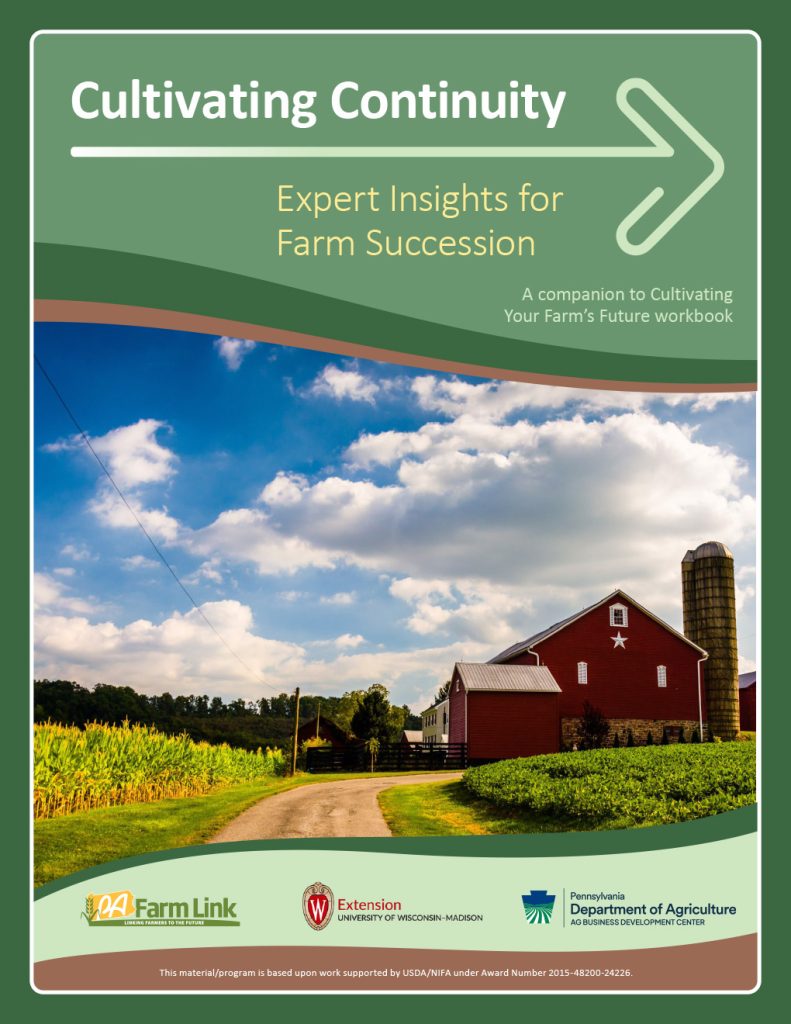
This article is a sample from a larger publication about farm succession, titled “Cultivating Continuity: Expert Insights for Farm Succession“
About the Authors

Shannon L. Ferrell, M.S., J.D.
Professor, Extension Specialist – Agricultural Law
Oklahoma State University Department of Agricultural Economics

Garrett Reed, M.S., J.D.
Associate Attorney
McAfee & Taft, P.C.