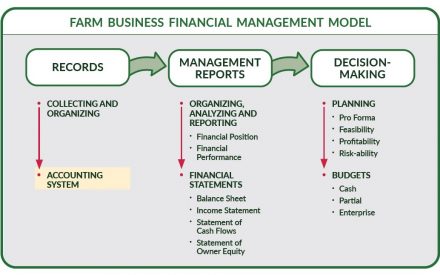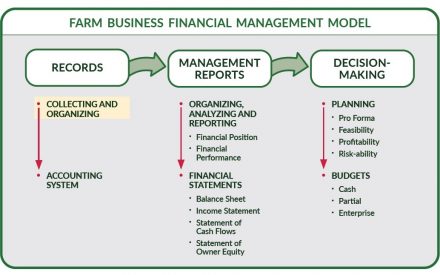
The balance sheet is a report of the farm business’s financial position at a given moment in time. It lists assets, liabilities, and net worth (owner’s equity), and represents a snapshot of the farm business as of a certain date.
Introduction
The balance sheet is referred as such because it adheres to the Universal Accounting Equation:
Assets = Liabilities + Net worth (Owner’s equity)
- Assets: Items owned by the farm business that have value.
- Liabilities: Financial obligations (debts) of the farm business that are owed to others.
- Net Worth (Owner’s equity): The value of the farm business owned and free of debt.
The balance sheet is also known as a “net worth statement” or “statement of financial position” because of the importance of net worth with respect to representing the farm business’s financial position.
Assets are classified on the balance sheet as to their useful life in the farm business: current (used or sold within 1 year or within the normal operating cycle if longer than 1 year) and non-current (held for more than 1 year). Liabilities are classified similar to assets: current (due within 1 year) and non-current (due beyond 1 year).
In agriculture, non-current assets and liabilities may be further divided into intermediate (more than 1 year but less than 10 years) and long-term (more than 10 years). The purpose of comparing intermediate or long-term liabilities to intermediate or long-term assets is to determine whether the debt is structured consistently with asset life and to evaluate the overall balance sheet structure.
The Farm Financial Standards Council (FFSC) provides the specific standards and structure for the balance sheet. This article provides a concise and practical presentation of the balance sheet in compliance with the FFSC guidance.
Balance Sheet Structure
The balance sheet is divided into two columns: assets on the left side and liabilities on the right side. The net worth will appear on the bottom-right side. The value of the assets will balance or equal the sum of the liabilities and net worth (owner’s equity).
| Balance Sheet | As of Date (xx/xx/xxxx) |
|---|---|
|
Assets
| Liabilities
Net Worth (Owner’s Equity) |
Preparing Your Balance Sheet
The Extension Balance Sheet Tool consists of Excel worksheets that provide a means and assistance in developing your balance sheet. The Balance Sheet Tool uses macros to assist with data entry. After downloading the tool, be sure to click on the box “Enable Macros.” The Balance Sheet Tool consists of a main tab or worksheet, “Instructions and Start Page,” and additional tabs that support the development of the balance sheet.
Share your feedback on this tool by contacting our Extension team at farms@extension.wisc.edu
Summary
The first financial management report often created for the farm business is the balance sheet. The balance sheet is one of the most commonly used financial reports and displays what the farm business owns and what is owed. The difference represents the owner’s claim to assets or equity in the farm business. A well-prepared balance sheet can describe the farm business’s financial position, measured by solvency and liquidity ratios and measurements. To understand the farm’s financial performance, the balance sheet and the income statement must be evaluated together to calculate profitability ratios and measurements.
Test your knowledge of the balance sheet
True or False: The balance sheet will specify a point in time.
Answer: TRUE. The balance sheet uses a specific moment in time, rather than a period of time.
A balance sheet includes which of the following?
- Assets
- Expenses
- Net worth
- Liabilities
- Income
Answer: 1. Assets, 3. Net worth, 4. Liabilities
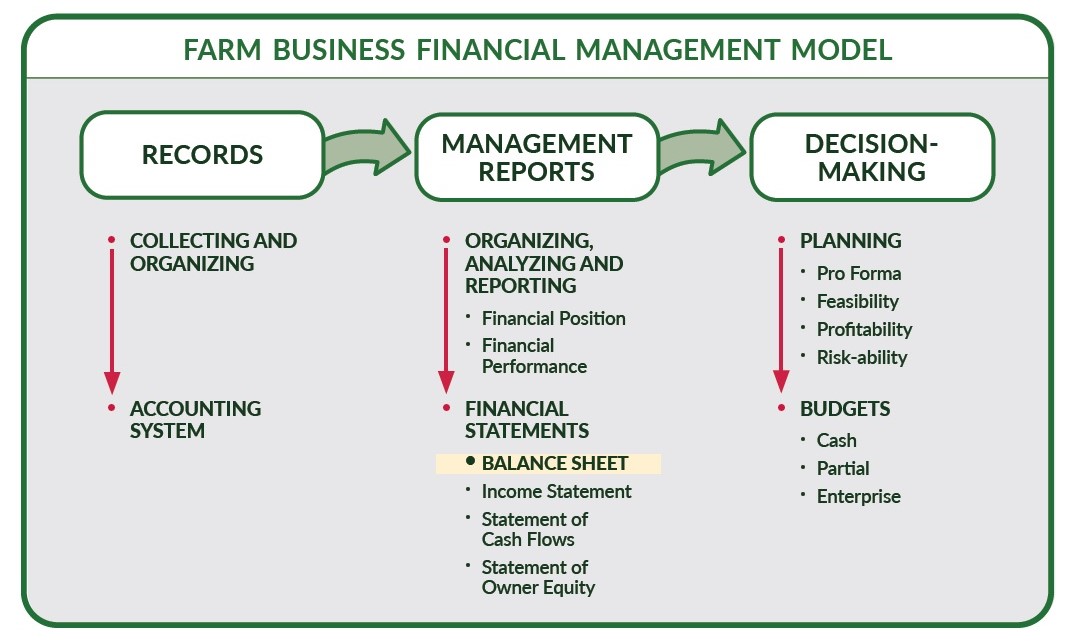
This video is one in a series to introduce you to the farm business financial management model. The presentation contains information on preparing your farm’s balance sheet.
The balance sheet is one of the most used financial reports and displays what your farm business owns and what is owed. The difference represents your claim to assets or net worth in your farm business.
More Farm Pulse Financial Management Resources
References
Farm Financial Standards Council. (2021, January). Financial guidelines for agriculture.
This material is based upon work supported by USDA/NIFA under Award Number 2018-70027-28586. Preparing the Balance Sheet (2021), drafted by Katie Wantoch, UW–Madison Division of Extension; reviewed by Kevin Bernhardt, UW Center for Dairy Profitability/UW-Platteville, and Jenny Vanderlin, UW Center for Dairy Profitability; based on material from Understanding the Farm Balance Sheet, Part I Factsheet (2018), by Sandy Stuttgen, UW–Madison Division of Extension.