In recent marketing years, the payouts from ARC and PLC programs have shown variability, largely influenced by market and local conditions. This variability can make it challenging for individual farmers to choose the most suitable option for their specific area and crop. To assist with this decision, this What-If Tool can help Wisconsin producers analyze potential payments at various price levels and county yields.
How to use the What-If Tool
This article introduces a decision-making tool designed to help producers determine whether to enroll in the Agriculture Risk Coverage (ARC) or Price Loss Coverage (PLC) program, following a brief historical overview of both programs.
Following the USDA announcement, agricultural producers have an opportunity to choose between ARC and PLC for their base acres in 2026. The deadline to elect or make revisions is December 11, 2026, with potential payments issued by October 2027.
Under the PLC program, payments are only triggered when market year average price of a covered commodity falls below its effective reference price[1]. Unlike PLC, ARC has two types:
- County ARC (ARC-CO) is structured to provide payments when actual county revenue[2] falls below its guaranteed level for a program commodity.
- Individual ARC (ARC-IC) triggers payments to producers when actual farm-level revenue is less than its guaranteed level.
We focus on ARC-CO and PLC because of the low ARC-IC enrollment rates in Wisconsin. Figure 1 shows Wisconsin enrollment rates of base acres for corn, wheat, oats and soybeans from 2020 to 2025. The enrollment of Wisconsin corn and wheat base acres experienced a major shift after 2021. Despite absence of both ARC-CO and PLC payouts in 2020 and 2021, corn producers may have expected significant yield fluctuations in subsequent years, leading them to enroll in ARC-CO. With PLC providing no payouts for wheat in 2021 and ARC-CO paying out $2,087 according to USDA Farm Service Agency (FSA) data, wheat producers may have anticipated yield fluctuations, prompting their shift to ARC-CO.
Figure 1
Enrollment Rates into ARC-CO, ARC-IC and PLC by Commodity, 2020-2025
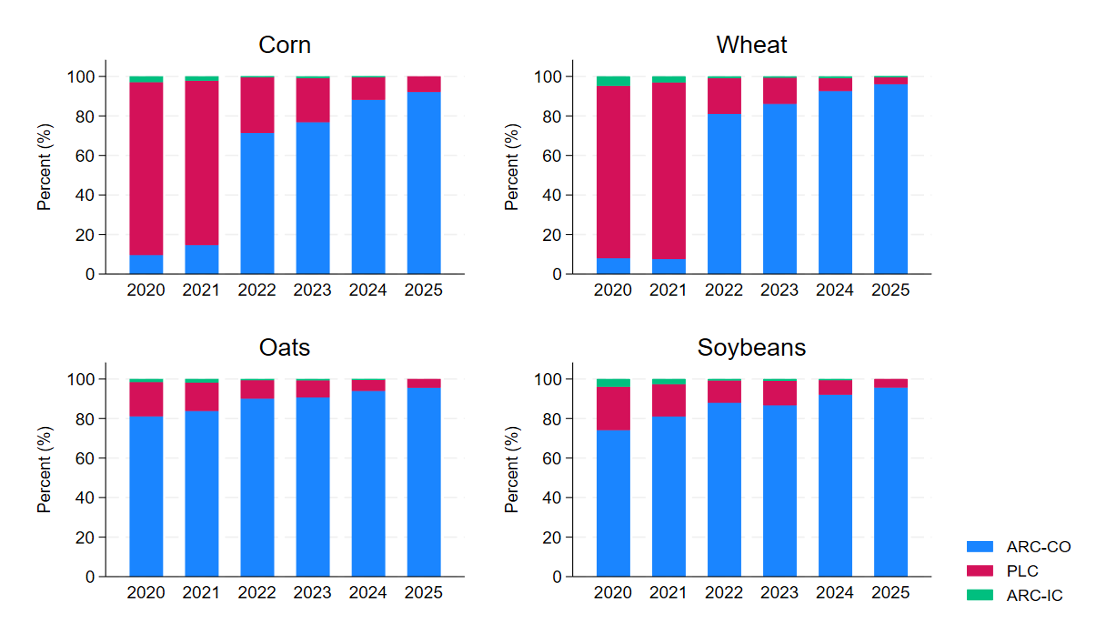
ARC-CO enrollment rates have an upward trend for all four commodities. As shown in Figure 1, at least 80 percent of oats base acres are enrolled in ARC-CO from 2020 to 2025, and more than 70 percent of soybeans base acres are enrolled in ARC-CO.
Figure 2 displays the prices for major commodities in Wisconsin from 2020-2026. PLC payouts were not triggered for corn, oats and soybeans from 2020-2024 because the effective reference prices (ERP) were below the marketing year average prices (MYAP).[3] In 2025, PLC payouts were triggered for corn and soybeans. Wheat producers who enrolled their base acres in PLC received payouts in 2020 and 2025 because the marketing year average price was lower than the effective reference price.[4] However, PLC payouts for wheat were not triggered from 2021 to 2024 because of high prices.
Producers of corn, soybeans and oats may have received ARC-CO payout due to yield shortfalls despite marketing year average prices (MYAP) being greater than ARC-CO trigger prices from 2020-2024.[5] For instance, in Burnett and Oneida counties, corn producers who enrolled their base acres in ARC-CO received payouts in 2023 despite high prices. Oats producers in Polk County who chose ARC-CO in 2023 also received payouts. In 2025, ARC-CO payouts were triggered for certain crops in some counties. In Burnett county, ARC-CO payouts were triggered for oats in 2025. For corn, ARC-CO payouts were triggered in Clark county in 2025. In Burnett and Calumet counties, ARC-CO payouts were not triggered for corn base acres enrolled in the program.
Figure 2: Prices of Selected Program Commodities, 2020-2026
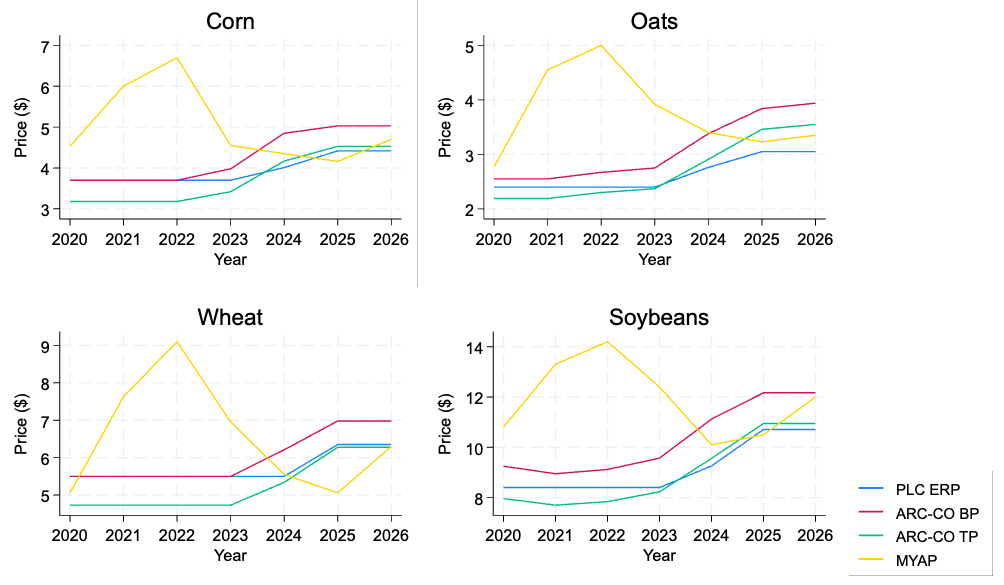
Benchmark prices, trigger prices and effective reference prices for selected commodities have increased in recent years. In 2026, benchmark and trigger prices are higher than effective reference prices for corn, oats and soybeans. For wheat, the effective reference price lies between the benchmark and trigger prices. According to the WASDE report in October 2026, projected prices for corn, oats and soybeans lie above their respective effective reference prices, indicating that PLC payouts are less likely. For wheat, the effective reference price is higher than the projected price, implying that PLC payouts are likely. ARC-CO payouts may be triggered for these four commodities if county yields fall significantly below their benchmark levels.
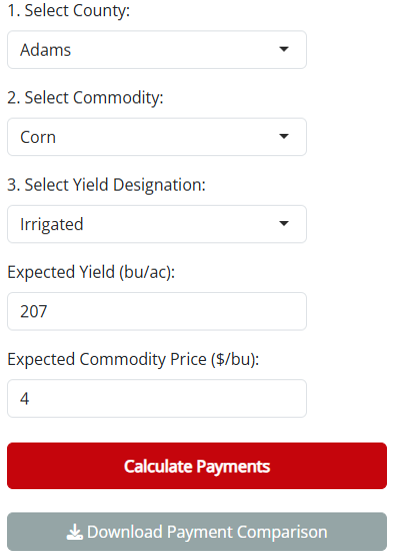
In recent marketing years, the payouts from ARC and PLC programs have shown variability, largely influenced by market and local conditions. This variability can make it challenging for individual farmers to choose the most suitable option for their specific area and crop. To address this, the UW-Madison Division of Extension Farm Management Program has developed a tool (What-If Tool) to help Wisconsin producers analyze potential payments at various price levels and county yields. This tool allows users to select the county, crop, ARC-CO yield designation.[7] Additionally, users can calculate both PLC and ARC-CO payouts by entering expected prices and yields. After the above selections and data entries, users should click “Calculate Payments” to observe potential payouts for ARC-CO and PLC.[8] Users are also able to download a picture of the output.
Figure 3 displays the tool using Adams County as an example. To view payouts for irrigated corn, users should select corn under “Select Commodity” and irrigated under “Select Yield Designation”. Users can proceed to enter expected commodity price of $4 and yield of 207 bushels/acre and click “Calculate Payments” to view the payouts per base acre.
Figure 3: Preview of Tool
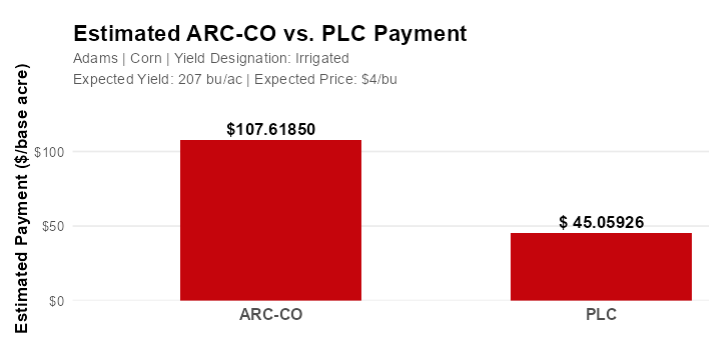
Users can download the output by clicking the “Download Payment Comparison” button. Figure 4 displays the output for Adams County. With the data in Figure 3, ARC-CO offers a higher potential payout per base acre than PLC: ARC-CO payout stands at $107.62 per base acre while that of PLC is $45.06 per base acre.
Figure 4: Potential ARC-CO and PLC Payouts in Adams County
Wisconsin producers can also use the What-If Tool to compare potential payouts for other covered commodities, including sorghum and sunflower seeds.
Footnotes
[1] The legislation specifies how the effective reference price for each commodity is determined.
[2] Actual revenue is the product of county yield and market year average price. The guaranteed level of revenue (guarantee revenue) is 90% of benchmark revenue, which is a product of the Olympic average of market prices and county yields from 2020-2024.
[3] The Effective reference price can vary annually. Benchmark price is the 5-year Olympic average MYAP, calculated using the 5 years preceding the year prior to the program year.
[4] Producers received a higher of PLC or ARC-CO payouts in 2025.
[5] Under the current legislation (OBBBA), trigger price is 90% of benchmark price, which indicates that ARC payouts are triggered when prices fall below this threshold with yields matching their benchmark level.
[6] In 2026, MYAP is projected.
[7] After these selections, the app updates the expected yields to the ARC-CO benchmark yield; however, users can make changes.
[8] ARC-CO Payment=0.85 x payment rate, PLC payment= 0.85 x plc yield x plc payment rate. ARC-CO payment rate=guarantee revenue-county revenue and PLC payment rate = Effective reference price – marketing year average price. PLC yield is the established yield. This tool uses 2025 PLC yield for calculations.