

In a previous article (Nov. 14, Farm Management), we discussed the ARC and PLC payments that Wisconsin farmers received in October 2025 for the 2024 crop year. As part of our ongoing series on ARC and PLC program updates, we extend that analysis by examining projected payments for the 2025 crop year—payments that farmers will not receive until fall 2026. We hope these results will help farmers plan their cash flow over the next several months.
A key feature for 2025 payments is policy changes introduced under the One Big Beautiful Bill Act (OBBBA) that made major adjustments to program parameters. Reference prices and effective reference prices were increased, as well as the ARC county guarantee and the maximum ARC payment rate. These changes take effect for the 2025 crop year. Because these changes were made late, for the 2025 crop year only, farmers will receive the higher payment between ARC and PLC, regardless of which program they enrolled in. Expansion of base acres and loan rate revisions do not become effective until the 2026 crop year.
The goal of this article is to provide Wisconsin farmers with early insights into their potential 2025 ARC and PLC payments—information that, while preliminary, can help guide planning and risk-management decisions for the upcoming production year. Several national analyses have discussed how OBBBA may affect ARC and PLC payments in 2025 and beyond (Nov. 18, Farmdoc Daily and Nov. 14, RaFF). Here, we draw on payment projections from the Policy Design Lab to focus specifically on Wisconsin scenarios.
Figures 1 to 3 below show the projected ARC/PLC payment rates for corn, soybeans, and wheat in Wisconsin for the 2025 crop that will be paid in October of 2026.
In these projections, the 2025 effective reference prices for corn, soybeans, and wheat are $4.42, $10.71, and $6.35 per acre, respectively. The projected 2025/2026 MYA prices—$4.00 for corn, $10.50 for soybeans, and $5.00 for wheat—are based on USDA WASDE estimates and ARC/PLC program data released on November 14, 2025 (table 1 in the Nov. 18, farmdoc daily).
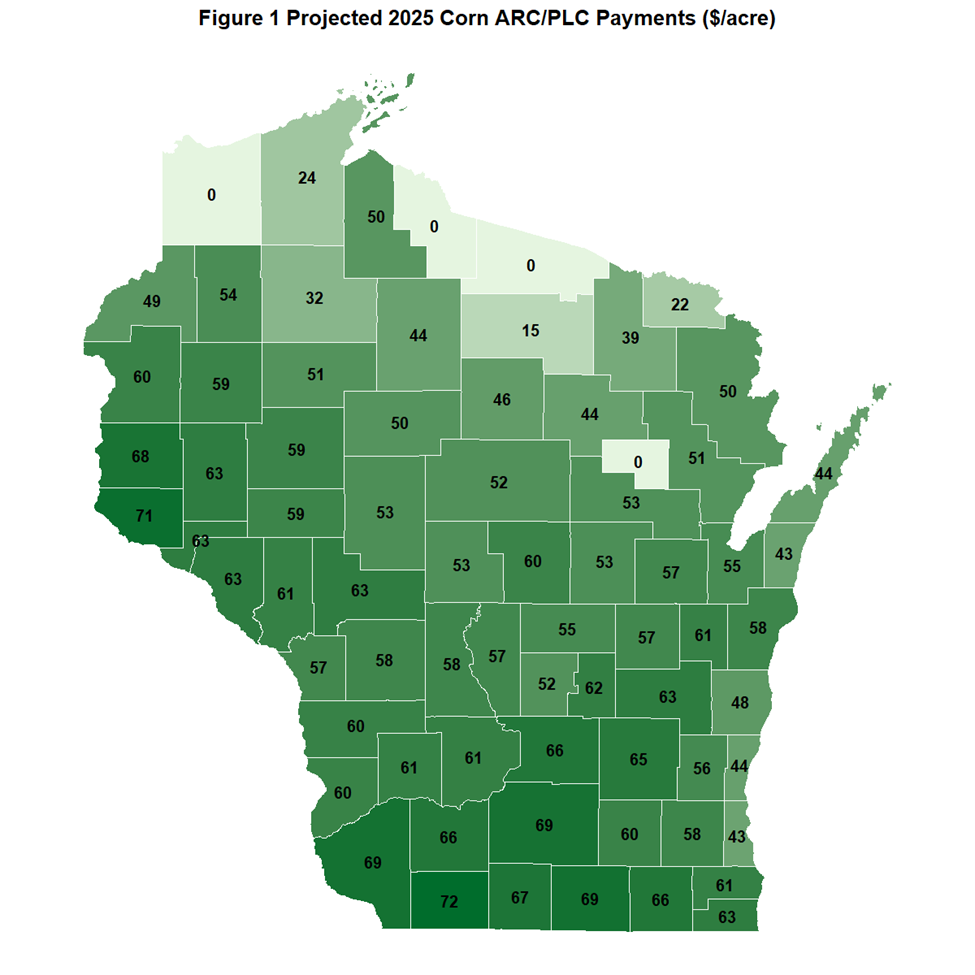
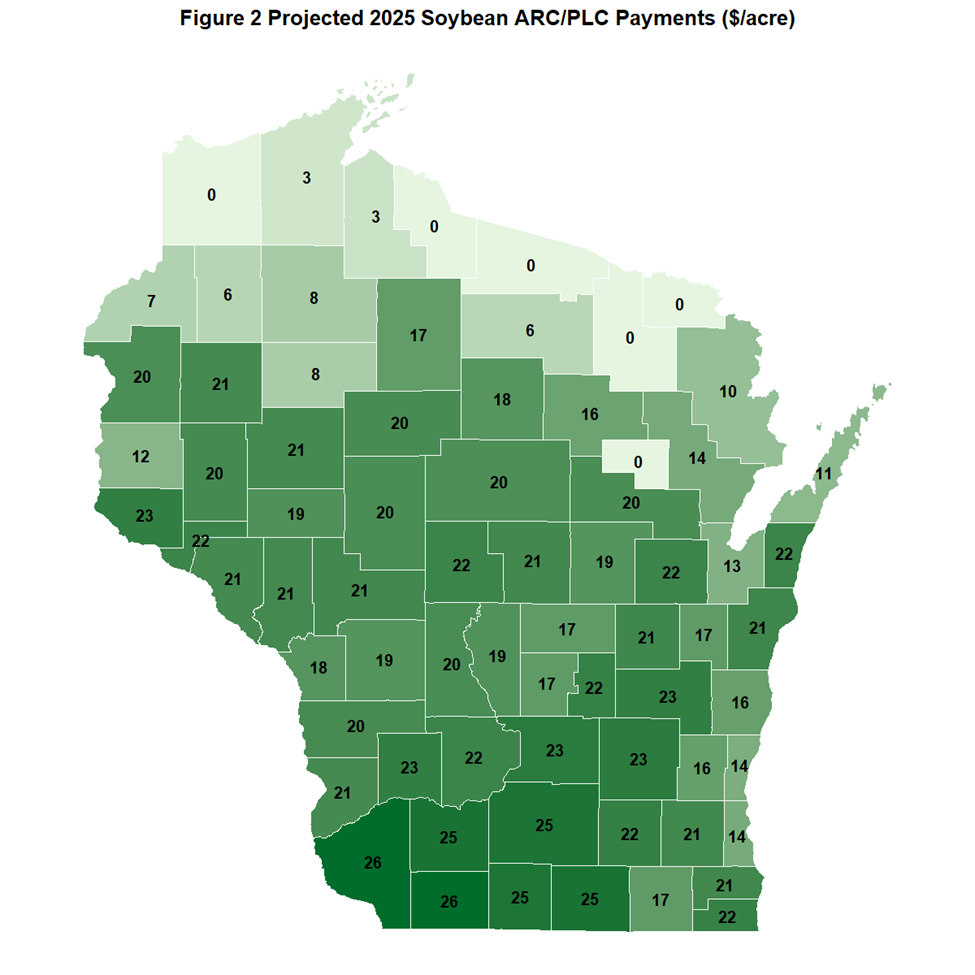
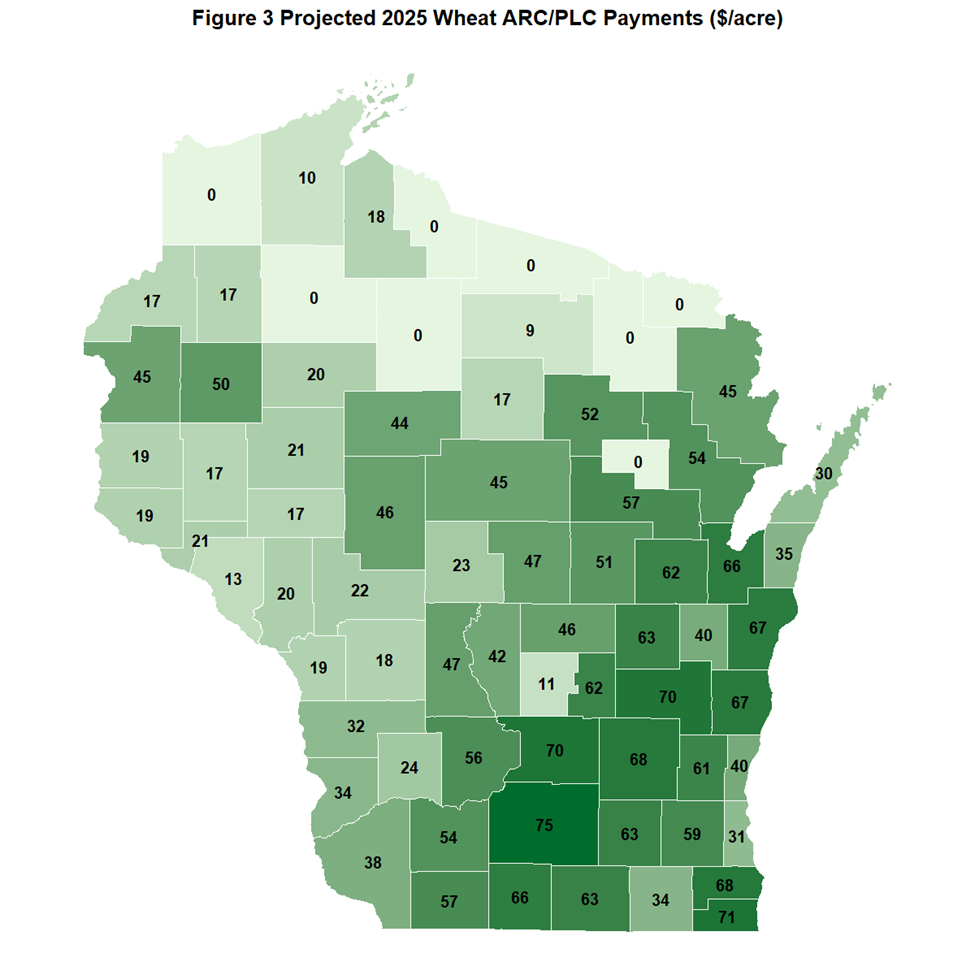
There are a few points to keep in mind. These projections use USDA season average price estimates for 2025 from the November 14th WASDE report. Prices for the 2025 crop year will not be finalized until several months later, on August 31, 2026, for corn and soybeans, and May 31, 2026 for wheat. These projections use county average PLC program yields; farm payments will be higher or lower depending on whether your farm’s PLC yields are higher or lower than this average. Also, final crop prices and county average yields to determine ARC payment rates are simulated. Lastly, these are payment rates per base acre; final payments per base acre will be 88% of these payment rates based on the updated OBBBA formula.
Across the four crops, the projected 2025 ARC/PLC payment rates reveal strong geographic patterns that reflect Wisconsin’s underlying production regions, historical program yields, and program sensitivities. Corn exhibits the most pronounced north–south gradient. Southern and southwestern counties—such as Grant, Lafayette, Iowa, and Rock—are projected to receive the highest corn payment rates, often exceeding 65 dollars per acre. These counties benefit from stronger historical yields and greater base acreage. Central Wisconsin counties fall into a moderate range around 50 to 60 dollars per acre, while the northern tier of the state shows very low or zero projected payments. This pattern is consistent with lower historic corn production and more limited program exposure in northern counties.
Soybean ARC/PLC payment rates follow a similar geographic structure but at a smaller magnitude. Payment rates in southern Wisconsin cluster between 20 and 26 dollars per acre, with the highest levels again in Grant, Lafayette, and Green counties. Central counties tend to fall in the upper teens to low twenties, while northern Wisconsin shows minimal payment rates, including many counties with zero projected support. Soybean payment rates are more tightly concentrated in a narrower band than corn, reflecting lower payment rates overall and smaller regional differences in historical soybean yields.
Wheat payment rates present perhaps the widest range of payment outcomes. Southeastern and south-central counties—including Jefferson, Walworth, Racine, and Rock—show the strongest projected wheat payment rates, frequently above 60 dollars per acre. An east-central corridor also displays elevated wheat payment rates compared with other regions. Central Wisconsin shows moderate values that generally fall between 30 and 50 dollars per acre. In contrast, northern counties again project little to no wheat support, reflecting limited wheat acreage and lower historical yields in that region.
Taken together, the maps indicate that southern Wisconsin continues to be the region where base acreage and historic yields support the strongest ARC/PLC payments across major commodity crops. Central Wisconsin follows with moderate support, while northern counties consistently show minimal payments. The differences across crops also highlight how payment exposure varies by historical planting decisions and base allocation, with corn and wheat driving the highest payments.