

Home » Forward Farm Safety Toolbox » Forward Farm Safety Toolbox – Skid Steer Loaders
Forward Farm Safety Toolbox – Skid Steer Loaders


Farm Safety Toolbox
Home » Forward Farm Safety Toolbox » Skid Steer Loaders
Skid Steer Loader Safety Training
Skid steer loaders are compact, powerful machines used on farms to handle many different jobs. They can lift, move, and load materials like feed, manure, soil, or hay bales. With different attachments, they can also dig, grade, clean barns, or clear snow. Their small size and tight turning ability make them especially useful in barns, pens, and other tight spaces where larger equipment can’t fit. Discover ways to safely operate a skid steer loader on your farm.
Learn
Instructions: Get your team together and share the following information out loud, promoting participation.
Did You Know?
- Crushing and rollover injuries with skid steers are common. Nearly 3 of 4 cases involve operators getting pinned between the skid steer frame and the lift arm or bucket.
- Both operators and bystanders/observers can be severely injured or killed if a runover occurs.
- Skid steer loaders are large, heavy machines (between 4,000-10,000 pounds—twice as heavy as a truck) that can damage property.
- Skid steer injuries are expensive; two or three days in the hospital can cost $50,000 or more.
What Can Happen to You?
- Start a conversation about the possible impact on individuals, families, the farm, etc. if an incident occurs.
- Ask participants whether they’ve seen or experienced unsafe skid steer practices.
- Types of injuries
- Outcome of typical injury: disability, cost, pain, guilt
- Damage to facilities – gates, doors, pens, other structures
- Injury or harm to animals
- Death
- Other?
What are the Risk Factors?
- Pinch points: The hydraulics used for lifting and tilting create strong crush and pinch point hazards.
- High center of gravity: Skid steer loaders can have a high center of gravity when the arms are up. Why is this dangerous? How can you reduce risk? (Drive slowly, avoid steep slopes, keep loads low when moving)
- Heavy and big machines: Work areas are often tight and narrow, such as aisles, doorways, and other narrow spaces. Where are some challenging and dangerous spots on your farm?
- Blind spots: There are many blind spots, especially behind the operator, to the sides, when the loader blocks the view, or in low light or glaring conditions.
- Expirience level: Inexperienced operators may not recognize hazards or respond safely.
- Fast-paced enviroment and long working hours: Operators who are rushed, tired, or distracted are more likely to make mistakes.
- What else have you seen or experienced?
Explore
Instructions: Hands on time! Go to the skid steer and follow the activities below.
Exploration Activities (pick one or two)
Demonstrate
- Three points of contact: Have a volunteer demonstrate how to safely enter and begin to operate a skid steer loader. Ask observers to comment on what went well and what should be improved.
- Stability: In an outdoor setting, safely raise the bucket with or without a heavy load. Discuss stability issues. How does stability change with weight? Height? Speed? Moving uphill or downhill? Turning?
- Crush points: To show how powerful crush points are, carefully place a large pumpkin or watermelon in a major pinch/cush area (near lifting arms or under tracks/wheels). Crush it while participants stand at a safe distance.
Walk-Around
- Machine condition and safety information: Locate safety information inside the cabin, do a walk-around, and discuss areas to improve machine condition, such as addition of safety devices, maintenance, repair needs, and housekeeping.
- Identify safety labels: Go inside the cabin, identify at least two safety labels and discuss what they are for.
- Safety features: Ask volunteers to point out the key safety features on your skid steer (seat belt, mirrors, back-up alarm, etc.). Why are they important? How should they be used to fully protect people?
- Identify issues: Set up a skid steer loader with several safety hazards (missing fuel cap, items left on bucket or tracks, deflated tire, dirty glass panels, etc.) and have participants identify what must be corrected before use.
Story and Lessons from Participants
- Encourage participants to share stories or examples of situations, close calls, or actual incidents they’ve seen.
- How did it happen? What happened afterward? What were the outcomes (cost, pain, medical, damage, emotional reactions)? What lessons did they learn from this experience?
Case Study
A 67-year-old male farmer was using an older skid steer loader to clear manure and load it into a truck. The loader had been damaged in a barn fire and was missing key safety features, including the cab side screens. The seat-activated safety lockout switch did work. Three of the four tires were old truck tires intended for road use.
While loading manure on a wet, manure-covered concrete pad, the left rear truck tire blew out. The farmer leaned his head outside the unguarded cab opening to look at the flat tire while the bucket was raised. As he leaned out, he activated the lift-arm foot pedal. This caused the arms to drop and crush his head between the lift arm and the window frame. A witness nearby summoned help, but the operator died at the scene.
DISCUSS:
- What factors contributed to this incident?
- Operator factors?
- Machine/hazard factors?
- Surrounding conditions or other factors?
- If you were to go back in time and advise this farmer, what is the most important advice you can give?
- How does this incident compare to your experience operating a skid steer?
Non-Negotiables
Now that you’ve had a chance to explore a skid steer loader, let’s review the non-negotiable safety rules. These are not guidelines or preferences; they are mandatory requirements that apply every time, to everyone—regardless of situation, location, or role.
- Inspect the skid steer and worksite before starting work. Why is this important? What do we look for?
- Maintain three points of contact when you enter and exit the machine. Why three points?
- Always buckle seat belt and engage safety bar or other safety devices.
- Never work beneath a raised bucket unless lift-arm supports are locked.
- Carry loads low and slow.
- Keep heavy end uphill on slopes.
- One seat = one rider.
- Look left, right, front, and behind you before moving.
- When working near a skid steer, always assume the operator does not see you.
- Verify that buckets and attachment are fully secured before operating.
Solve
Instructions: Lead a discussion on how to apply toolbox concepts to your farm.
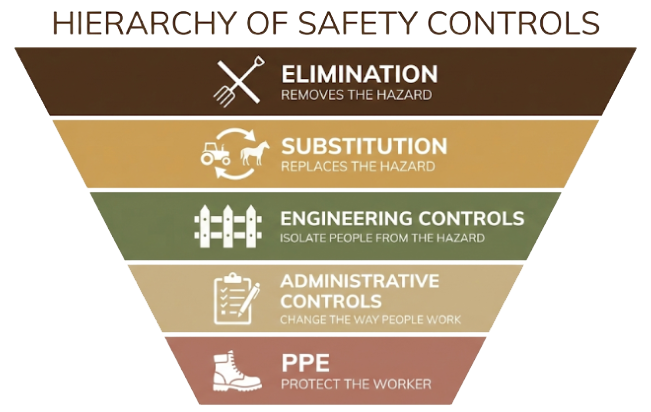
1. Explain the hierarchy of controls at each level
The hierarchy of controls is a standardized, five-level framework used in occupational health and safety to minimize or eliminate employee exposure to hazards.
Examples:
- Elimination: Can we clean the area (or carry the item) without using the skid loader?
- Substitution: Can we use a ladder to reach that high spot?
- Engineering controls: Can we install a backup alarm/camera?
- Administrative controls: All new operators must complete initial training before working on a skid loader.
- PPE: Hearing protection, high visibility clothing, safety glasses, etc.
2. What about my farm?
Instructions: Now we will apply what we learned today. Follow the activities.
Form breakout groups
- Ask participants to divide into groups of 3-4 (or discuss with the trainee if there is only one).
- Each group designates one person as the “reporter.”
Discuss
- How does today’s training relate to the things that happen on your farm? (Hazards, risk factors, non-negotiables, stories)
- What other non-negotiables apply to your farm?
- How can we apply the ideas from the hierachy of controls?
After 5-10 minutes, have groups “Report Out”
- Instructors should write down key ideas, insights, and solutions shared by groups.
- Give positive feedback as participants suggest solutions. This reinforces good safety thinking.
3. Give each person a “pledge form.”
- Participants should write down the top three safety actions they learned today that will improve their ability to safely operate a skid steer. It is okay to write more than three, but they should clearly identify the highest-priority items.
- Answers should be specific and actionable. For example, instead of “improve visibility,” write “install mirrors to improve visibility.”
- For each action, indicate who will do it and when it will be completed. Focus on concrete, prioritized next steps
- Decide what you’re going to do with “pledge” information.


References
- NIOSH. Preventing Injuries and Deaths from Skid-Steer Loaders. https://www.cdc.gov/niosh/docs/2011-128/pdfs/2011-128.pdf
- Skid-Steer Safety for Farm and Landscape https://extension.psu.edu/skid-steer-safety-for-farm-and-landscape
- ProPublica finds police missed key details in death of immigrant boy on Wisconsin farm (from Axios) https://www.axios.com/2023/02/23/propublica-immigrant-boy-wisconsin-dairy-farm