Introduction
How much dairy Santa’s tradition adds up to in Wisconsin and across the United States
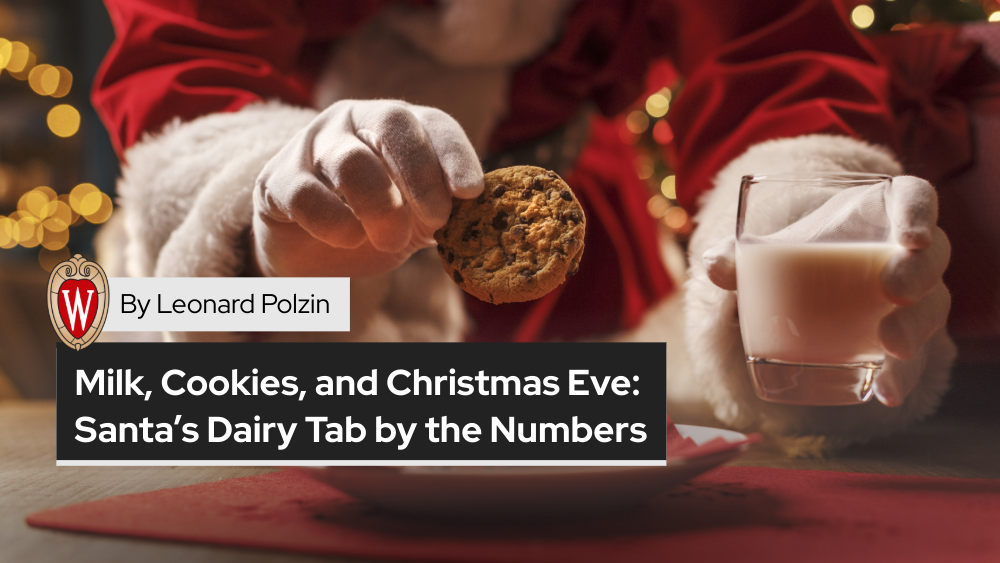
On Christmas Eve, one of the most familiar holiday traditions quietly repeats itself millions of times. A glass of milk. A cookie. Set out with care and a bit of excitement, especially in homes with children.
But when that tradition is viewed through a dairy economist’s lens, the numbers start to add up quickly.
This holiday-themed article takes a light-hearted look at how much milk and butter Santa would enjoy on Christmas Eve if he stopped at participating households with children, enjoying one standard serving of milk and one cookie at each stop. The results are shown for Wisconsin and the United States.
How the estimates were built
Who gets a Santa stop?
Rather than assuming every household takes part, Santa’s stops are anchored to households with children, where the milk-and-cookie tradition is most common.
Two groups are examined:
- Households with children under 18
- Households with children under 10, as a sensitivity case
To reflect the fact that not all households with children participate in Santa traditions, a 70 percent participation rate is applied. This middle-of-the-road assumption keeps the estimate realistic while still honoring the tradition.
What’s on the plate?
At each stop, Santa enjoys:
- One glass of milk: 8 fluid ounces (0.0625 gallons)
- One cookie: made with one tablespoon of butter
Conversions and production benchmarks
- One tablespoon of butter weighs about 14 grams (0.0309 pounds)
- Producing one pound of butter requires roughly 21.8 pounds of farm milk on a milk-equivalent basis
- One gallon of milk weighs 8.6 pounds
- Average milk production:
- United States: about 66 pounds per cow per day
- Wisconsin: about 70 pounds per cow per day
Estimated Santa stops (after participation adjustment)
| Geography | Household Definition | Participating Households |
|---|---|---|
| United States | Children under 18 | 23,545,000 |
| United States | Children under 10 | 12,523,000 |
| Wisconsin | Children under 18 | 447,200 |
| Wisconsin | Children under 10 | 237,900 |
Amount of milk and butter enjoyed on Christmas Eve
| Geography | Definition | Fluid milk (gallons) | Butter (pounds) |
|---|---|---|---|
| United States | Under 18 | 1,471,600 | 726,000 |
| United States | Under 10 | 782,700 | 386,000 |
| Wisconsin | Under 18 | 27,950 | 13,800 |
| Wisconsin | Under 10 | 14,870 | 7,340 |
That is a lot of milk glasses emptied and a lot of cookies enjoyed in a single night!
Why butter really moves the needle
Butter may not be obvious in a single cookie, but it carries a big footprint in milk terms. Butter is almost entirely milkfat, which means it takes a large volume of milk to produce even a modest amount. As a result, when butter is converted back into its milk-equivalent, it often rivals or exceeds the fluid milk total. This is a useful reminder from dairy markets: milkfat-rich products punch well above their weight when it comes to milk demand.
Total milk-equivalent consumption
| Geography | Definition | Milk-equivalent from butter (gallons) | Total milk-equivalent (gallons) |
|---|---|---|---|
| United States | Under 18 | 1,837,000 | 3,309,000 |
| United States | Under 10 | 977,000 | 1,760,000 |
| Wisconsin | Under 18 | 34,980 | 62,930 |
| Wisconsin | Under 10 | 18,600 | 33,470 |
What this means in cow terms
To put the totals in perspective, the milk-equivalent amounts can be translated into days of production from a 100-cow herd, broken out by fluid milk and butter.
| Geography | Definition | Fluid milk (days) | Butter (days) | Total (days) |
|---|---|---|---|---|
| United States | Under 18 | 2,230 | 2,060 | 4,290 |
| United States | Under 10 | 1,190 | 1,090 | 2,280 |
| Wisconsin | Under 18 | 40 | 37 | 77 |
| Wisconsin | Under 10 | 21 | 20 | 41 |
Under the under-18 scenario, Santa’s Wisconsin dairy tab alone adds up to nearly two and a half months of milk production from a 100-cow herd.
Closing thoughts
A glass of milk and a cookie may feel like a small gesture, but traditions have a way of adding up. When repeated across thousands of homes in Wisconsin and millions nationwide, those familiar Christmas Eve plates quietly represent weeks, or even months, of milk production.
It is a reminder that dairy often shows up in the most ordinary and meaningful moments, especially during the holidays.
Under the under-18 scenario, Santa’s Wisconsin dairy tab alone adds up to nearly two and a half months of milk production from a 100-cow herd.
Published: Dec. 29, 2025
Reviewed by: Jeff Hadachek, UW-Madison Department of Agricultural and Applied Economics
References
- U.S. Department of Agriculture, National Agricultural Statistics Service. Milk Production, Disposition, and Income: 2024 Summary.
- U.S. Department of Agriculture, National Agricultural Statistics Service. Wisconsin Milk Production Reports, 2024–2025.
- U.S. Census Bureau. American Community Survey, Households and Families Tables.
- U.S. Department of Agriculture, Economic Research Service. Weights, Measures, and Conversion Factors for Agricultural Commodities.